Reading Time: 2 minutes

A new study by the Consumer Electronics Association (CEA)® “Getting Fit With Consumer Electronics” reveals that approximately half of U.S. online consumers used a fitness technology in the past year, and 37 percent anticipate purchasing a fitness technology in the next 12 months.

That fitness technologies help keep us motivated probably isn’t news to many of my Bitness.com brethren, but according to the study, 76 percent exercise alone (without the guidance of exercise professionals), and 74 percent of consumers exercise at home. Those are both good reasons to use technology to help assess fitness levels, set realistic and achievable goals as well as track the amount of daily physical activity. Our gadgets also help us to monitor calorie intake, track progress on fitness goals and ultimately help make the journey more fun and engaging.

“Fitness technologies can play a significant role in motivating consumers,” said Rhonda Daniel, manager of market research at CEA. “Compared to consumers who are not using fitness technologies, consumers who use these devices view exercise more positively, and are more likely to enjoy exercising and to view it as important to their health.”

CEA’s “Getting Fit With Consumer Electronics” presents the findings of an Internet survey administered to an online national sample of 1,303 U.S. adults between July 26 and August 5, 2010. The study was designed and formulated by CEA Market Research, the most comprehensive source of sales data, forecasts, consumer research and historical trends for the consumer electronics industry.

Source: Full release

Reading Time: < 1 minute

Over the years bitness.com has run a series of articles on gadget recycling and greener gadgets.

Since many of you likely received new and improved heart rate monitors, phones and other gadgets this holiday season, you might be faced with the dilemma of what to do with older electronics you no longer need?

The US Environmental Protection Agency (EPA)* provides information on where to donate or recycle old computer and other electronic products in your area. So if you can’t sell it on eBay or pass it down to a friend/family member, do the right thing and find a local donation or recycling center in your area through the EPA.

Happy Holidays!

* UK readers can look into programs such as MirrorGoGreen, or Google ‘gadget recycling.’ Readers in other countries are encouraged to do the same!

Reading Time: 4 minutes

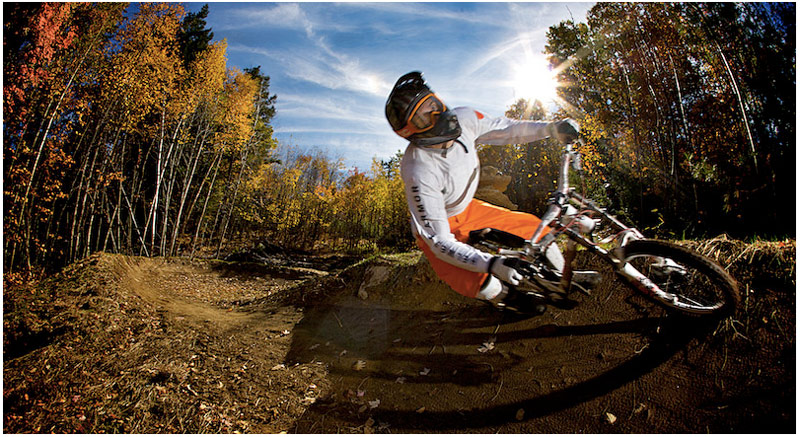
I was lucky enough to enjoy 3 early powder days last week in Snowbird, Utah. The conditions were not only amazing for early December, they were amazing for any day of any month. But more than fresh lines, blue skies and incredible terrain, what got me stoked the most was sharing it with two friends.

Copyright Justin Cash www.justincash.com

That’s the thing about about Stoke – it’s way better when shared with friends. Two friends that clearly understand this concept are Justin Cash (Woodstock, VT) and Mike Horn (Crested Butte, CO). After several years working together as photographer and writer in the outdoor industry, these stoke enthusiasts decided to launch their own media company to share the stoke and StokeLab.com was born.

In this interview, Justin and Mike share what get’s them stoked, how to capture those moments and what StokeLab does to evangelize the masses by spreading the stoke.

What gets you [StokeLab] stoked?
Spreading stoke far and wide, interacting with our readers/viewers, and putting out a kick-ass product with blood, sweat and tears – okay, nobody’s cried yet, but stoke never sleeps so it’s a lot of work. It’s really gratifying for us to create an alternative stoke-filled universe, and add at least a few positive, inspiring minutes to peoples’ lives.

With two issues under your belt you wowed us with photography and insightful stories. What’s the response been like?
Well, if we’re “wowing” people as you say, than that kind of response is all we could hope for. We’ve received a lot of compliments from a diverse group of readers, and feel we’re accomplishing our mission, or at least are on our way there.

How long does it take to produce a single issue and how often can we expect to see new issues?
New issue every two months, and each issue always takes longer than we plan for – the ideas come first, then we have to convert those ideas into stories, which requires shooting/requesting photos, assigning and editing stories, layout and design, and so on.

Can we ever expect to see Stokelab in print? Is that even a goal of yours?
“Never say never, but print is not our focus right now. Our goal is to continue refining the digital media experience, to make it more interactive and aesthetic. That said, Stokelab will evolve with its readership, and if our readers demand a print magazine down the line than it’s something we’d have to at least consider. But for now we’re capitalizing on the advantages of digital distribution and production, namely, delivering the magazine and all our content for free.

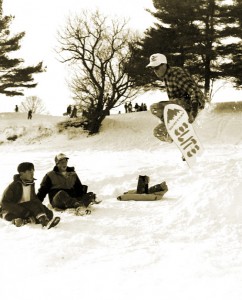
Bitness founder Lawrence Zevon gets methodical 25 years ago. Stokelab founder Justin Cash (seated on right with cap) clearly stoked! Photo by Jason Gould

With Stokelab it’s evident you practice what you preach. What are some of your favorite adventure sports and how did you come to discover them?
Justin – “I’d say my longest running passion would have to be snowboarding. I might even credit you, Larry (bitness.com founder), with turning me on to snowboarding back in ’85-’86. You showed it to Jason Gould and I, when I saw his red and black Burton Elite 140, I knew right then and there I needed one. More recently I’ve been enjoying fly fishing quite a bit in the summer (not so extreme). This winter I am planning on getting into SnoBlading, the sport has kinda died out a little, but I’m on a one-man mission to bring it back to the slopes.”

Mike – “Snowboarding is at the top of my list as well, with mountain biking a close second. I love surfing also but am not very good—at all. Being landlocked in Colorado doesn’t get you much wave time. My first snowboard was a Craig Kelly Air I bought at a thrift store for $15, with bindings. Still got it.

Is there any user-generated content at Stokelab, or do you generally work with select contributors?
We’re just getting started, and are very fortunate to have a bunch of contributors delivering top-level stories, imagery and video content. With two issues out, we’re also receiving more queries from writers and photographers looking to get involved. As for user-generated content, that is on our radar and we are always making efforts to interact with our readers as much as possible. We recently gave away a season pass to Jay Peak Resort, and asked our viewers to submit their stories of stoke, for example.

What are some tips for the amateur photographer to capture great adventure pics like we see on Stokelab.com and justincash.com?
Thanks for the compliment. Technically, I would suggest searching for cool and interesting angles, try to get real close to the action, or climb a tree to get a different perspective. Also, I would add, don’t be afraid to direct the athletes, tell them exactly what you are trying to create and exactly where the peak action needs to be. This will greaten your chances of nailing a banger image. In the end, I’d say shoot as much as you can and make sure you are enjoying what you are shooting – if you are your stoke will show through in your work.

Reading Time: 6 minutes

Okay, let’s just see a quick show of hands… How many of you already own a heart rate monitor of some description? Okay, quite a few of you. Alright, keep your hands up if you know how to use your HRM?  Hmmm, okay, a few hands went down. Quizzical looks on a lot of faces are telling me that a lot of you sort of know how to use your HRM, but are not sure.

Okay, one more round of questions, then: How may of you know about heart rate training zones? Okay, quite a few of put your hands up. Now, keep your hands up if you know about your heart rate training zones, as in your Max HR, your Aerobic Endurance zone, your Tempo zone, and so forth.  A few hands went down, but some more quizzical looks on faces.

You see, the problem is that, before I go and recommend which heart rate monitor you should buy for your training, I have to acknowledge that there is a lot of confusion and margin for error in this whole area of training with heart rate zones, which is why most of us buy an HRM.  So, I am afraid I feel the need to bore you with some explanations, in an attempt to clear up some of that confusion and reduce some of that margin for error. Then, we’ll get to the gadget stuff in a few minutes.

Heart rate training zones
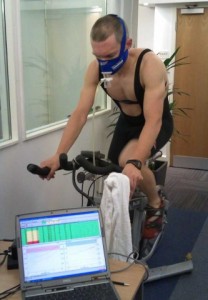
If you read some of the web sites, magazine articles, books or HRM owner’s manuals, it sounds like heart rate training zones can be calculated fairly quickly and then you can head off to do your exercise, confident that you are targeting a specific type of fitness. But, they’re not so easy to calculate accurately and most calculations that don’t involve a scientific test (usually something like a VO2max test) are going to be prone to a lot of error. Problem is that a VO2max test can be expensive ($100-200 or more), can be time consuming (about an hour in total), and require specialists to conduct them. It is sooooo much easier just to follow the “typical guidelines” and then get started than it is to find the time, money and appropriate specialist to do a VO2max test.

But, let me give you an example of how badly you can get it wrong if you follow some of the “typical guidelines”. Many will tell you to take the number 220 and subtract your age if you want to estimate your Maximum Heart Rate for running. So, a 45 year-old guy like myself should have a maximum heart rate of 175 beats per minute (bpm). Except, my Max HR was tested on a treadmill last year (need to get another test done this year, sorry for the old numbers) at 188 bpm. So, if I follow the “typical guideline” and decide I want to target a tougher training zone for intervals on the track, they tell me I should train at 80-85% of my Max HR, or a Tempo training zone of 140-149 bpm. Which would be completely wrong for me, because I found out last year that my Tempo training zone is 151-161 bpm (80-86% of Max HR). The 140-149 bpm zone would be totally counter-productive for me – not hard enough to be improving my speed or power, but too hard to develop aerobic endurance, and I would not see the kinds of fitness gains I had hoped for if I followed the “typical guidelines”.

So, if you want to take this stuff seriously, then get a VO2max test done by an experienced professional and get more out of your training and your HRM.

The other approach you could take would be much less expensive, much more time-consuming, require you to listen to your body, and won’t give you any useful numbers for a while. You could use a heart rate monitor and write down your heart rates at key points in your work-outs (you’ll have to talk to your coach about this for more specific details), and then after several months of regular recording of your numbers, alongside your pacing and Rates of Perceived Exertion, then it might be possible to estimate your personal heart rate training zones.

Heart Rate Monitors
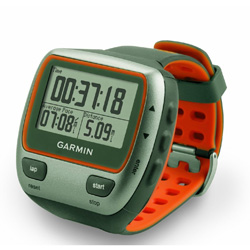
Well, the good news is that you don’t need to go out and buy the latest and most expensive HRM on the market. Of course, the latest and most expensive HRM on the market might have all the features you’d really like to have in an HRM (GPS mapping for speed, distance and route maps, downloadable to your computer, totally waterproof, extended battery life up to 20 hours, perfect for iron-distance triathletes…), like the Garmin Forerunner 310xt pictured to the right there ($300-400). But, there are also plenty of lower priced heart rate monitors that do a great job and cost about 1/4 the price.

So, what would I say are the most useful minimum set of features that an HRM needs to have?

  • Measuring heart rate reliably (well, duh!)
  • Stopwatch with lap counter (total number of laps depends on what you’re doing, really, but the more the better for long-distance people who might want to know their mile splits on a marathon, or perhaps their lap splits for a long track session)
  • Interval or count-down timer (useful if I say, want to do some fartlek with a burst of speed for 100 strides every 4 minutes, or something)
  • Waterproof to 50m (for those of us who also like to time our swims in the pool, not necessarily with HR, but still handy to be able to use the stopwatch with lap counter fully submerged in the water)

My favorite heart rate monitor in the “entry-level” category, that fits all the criteria mentioned above, sadly, is not made any more. It is a Nike Triax C8, it cost me about $80 five years ago, and it still works brilliantly to this day. Sadly, Nike seems to be more focused on footwear and watches that make fashion statements and I could not find any new HRMs currently available that I would recommend.

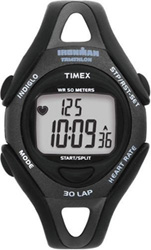
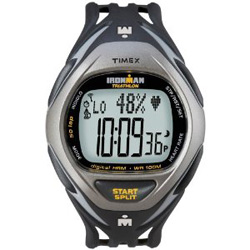
However, Timex do make some HRMs that are very reasonably priced and seem to have all the features mentioned above. I owned an Ironman-branded Timex watch before I had the Nike Triax HRM and it was very good value for money (but it was not an HRM) and lasted through my first 3 years of triathlon training in all kinds of water, weather and conditions. The Ironman Race Trainer model, pictured to the left, seems to be a very good one with all the features you might need to get started (and it can cost a lot less if you buy it on Amazon).

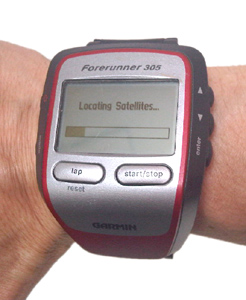
Garmin also do some very good models that are not as expensive as the 310xt. For example, I own a Forerunner 305 (the one pictured at the top of the article on my wrist) that costs about half of what the 310xt costs and is great for long runs. It is not water-proof, so I can’t wear it when I swim, and the battery life is only estimated for 8 hours, so I can’t use it for iron-distance training or racing situations. But, it has been so useful to have GPS distance and speed measurements available for the lower price.

More information, advice and selection
There are still a lot of other factors you may want to consider when buying and HRM. Is the heart rate strap compatible with your turbo trainer? Your treadmill? Your cycle computer? Will it work with Nike+ and iPod accessories? Other gadgets you might use in your training?  How does it feel when you are wearing it (the Garmin HRMs shown here in this article are very bulky and uncomfortable)?  These are also important questions to think about, and don’t make your purchasing decision any quicker or easier, but can make your usage of the HRM a lot more beneficial in your training.

HeartRateMonitor.co.uk is an excellent resource for people in the UK, and HeartRateMonitorsUSA.com for people in the US, who want to learn more about heart rate monitors, features, and objective product reviews, alongside an impressive range of products for sale on their web sites.  So, check them out, too, and get as much information as you can handle before making your purchase.

Reading Time: < 1 minute

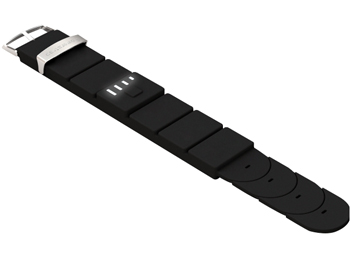
While Wonder Woman’s Amazonium bracelets were useful for deflecting bullets, they won’t charge an iPhone or a Nintendo DS. It’s because of this simple fact that we recommend the Orca PowerStrap in lieu of the bullet blocking power coveted by the Amazon women of Paradise Island.

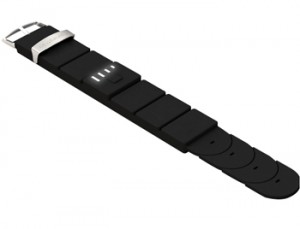
The Orca PowerStrap is a battery pack disguised as a watchband. It has a USB plug that will let you charge an iPhone, iPod, Nintendo DS/DS Lite/DSi, PSP and mobile phones from Samsung, Sony Ericsson, Nokia, Blackberry, LG and other devices through a USB connection.

To illustrate the amount of power provided, the Powerstrap (which reportedly takes five hours to fully charge) can provide up to 3 hours of talk time, or 8 hours of audio playback. It has four LED indicators that let you know how much battery capacity remains.

While it’s expected to be available in a number of colors (including red, yellow, green and blue) only black is currently available as far as we can tell. You can purchase it through IWOOT for $65USD for your favorite power-hungry gadget geek (or amazon) this holiday season.

Posted by: Lawrence

Reading Time: 4 minutes

Okay, you can see the article below with tips on what to eat, but perhaps the toughest part is figuring out when to eat. It’s tough because it’s going to be more personal and there are fewer general rules for you to follow. You really need to listen to your body to get it right in this area, and it may take a lot longer to get it right for you. But, let’s see if we can give you some good guidelines to get started…

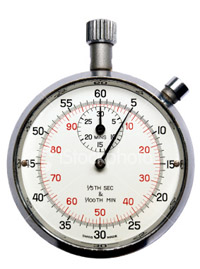
stopwatch

Eat something about 1-2 hours before exercise

Probably the biggest and silliest mistake made by most people I have coached is not eating enough to fuel their activity. Maybe they got into triathlon or other sports because they want to lose weight and so they think, rather simplistically, that they should eat much less and exercise much more. It sort of makes sense on paper, but if you wonder why you are dragging your ass around at the gym or on the bike or in the pool, then it’s probably because you can’t perform well on an empty stomach. Simple as that.  You need to eat. Just eat well.  See the article below “-what to eat”.

If you are exercising later in the day, then work backwards from your planned training time and get in a decent meal – not a huge meal – so you have enough food to fuel your session, but make sure that your stomach will be comfortable by the time you exercise. Some people will need more time before exercise than others. And allow for whatever digestive responses may occur when you eat something substantial, so that you are not always left feeling desperate to find a toilet in the middle of your training session.

If you are really serious about your training and you are training early mornings, then make it a part of your routine to get up at least an hour earlier to eat something.  It may not always be easy or convenient, or possible, but you might also be surprised to see how much of a difference it can make if you try it out some time. A little advanced planning can really help, too. I like to soak some oats, yogurt, fruit and honey all together in a bowl over night, so when I get up early the next morning it’s ready and waiting for me.

It also depends on what sort of exercise you plan to do and when. For example, if I am going out for a long bike ride early in the morning, I find that my stomach can tolerate a lot more food intake closer to the time of setting off on the ride than, say, if I were going off on a long run or a hard swim session.

Drink something 15-30 minutes before exercise

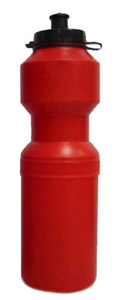
This is true throughout the day, but especially true if you are in the habit of getting up early to train first thing in the water bottlemorning. It’s just as silly to train on an empty stomach first thing in the morning as it is at any other time of the day, but I’m not going to preach too much at you and say that you need to get up at 5am to eat breakfast every time you want to run at 6am. Perhaps you can get up just 15 minutes earlier and have something to drink.

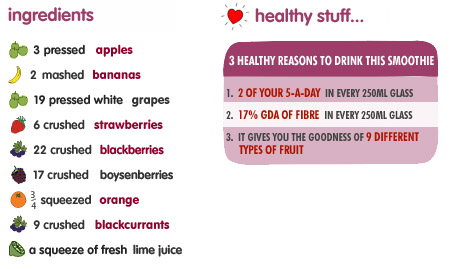
Smoothies, yogurt drinks, milk, chocolate milk, soy milk, fresh-squeezed fruit juices, or sports drinks are all decent drinks to get in you, and can provide some of the nutrients you will need for your exercise.  Again, make sure you are well-hydrated, but also make sure you are not over-doing it and bursting for a pee in the middle of your session.

Drink while you are exercising

Any activity that you do that elevates your heart rate and has you sweating, even a little bit, will be aided by continuously drinking throughout. Little sips and often. Not waiting until you are thirsty. You know the drill (if you don’t, then read the article below). And, if it is a reasonably high intensity session, then you probably want to drink more than just water. A sports drink or anything with a little sugar in it and some salt will do. You need to replenish energy stores and lost salts and minerals as much as you can while you are training.

One more thing: you need to drink even when you’re not aware that you’re sweating. For example, I sometimes see people swimming quite hard or long swim sessions without anything to keep them fuelled up during their session. People! You do sweat when you swim, you just don’t notice it! And, if you are training in the winter time when it is cold out and you are not sure if you are sweating, you probably are. So drink then, too.

Eat and drink when you are done

Your muscles will thank  you, your joints will thank you, and you will aid your body’s recovery if you can get some carbohydrates to replace lost energy stores and some protein to help rebuild muscle tissue. Despite what some may claim, there is not yet any scientific basis for a specific ratio of carbs and proteins (4:1, I’m talking about you) or an “optimal window” of recovery (that whole 30-minute business is anecdotal, which is perfectly fine, but not scientifically proven).  The only thing that has been scientifically proven is that you should eat “some carbohydrates and some protein” after exercise to aid recovery. So, that must be why I always crave a peanut butter and nutella sandwich after a training session. On wholemeal bread, of course. With some soy milk. Yep, that’s my favorite post-workout snack.

The longer your activity, the more you will need to replenish your body and keep eating and drinking steadily. Not eating a huge meal, and not using a long tough session as an excuse to binge on chocolate and potato chips and ice cream.  Just keep eating well, little and often.

Reading Time: 5 minutes

Right now, I have a lot of triathletes I am working with on their Annual Training Plans and laying out their training and racing goals for the year. Pretty much everyone has been asking me about what they should or shouldn’t eat and when they should or shouldn’t eat it. So, let’s see if I can answer most people’s questions in one go.

Tips for good sports nutrition are pretty much the same tips people will give you for healthy eating in your normal, day-to-day life. But, if you are planning some special sports activities or training plans, then there are a few extra points to bear in mind. Let’s start with the basics:

Several little meals throughout the day are better than one or two big meals

Big meals will often lead to over-eating, bloating, feelings of lethargy and sluggishness. Big meals are harder for your stomach to process and harder for your body to absorb all the nutrients you are feeding it. They are also sending your brain and body the message that every meal should be “super-sized” and you might end up only feeling satisfied when you over-eat. Small meals are easier to digest and absorb, and will leave you with less feeling of being bloated and sluggish.  When you are training well and regularly, you will probably need to eat more to fuel your work-outs, so you should try to do that by eating more often in small quantities rather than eating much larger meals.

Drink little and often
Drink water, people, water – not beer or wine or vodka.  This is basically the same thing as the statement above, but applied to drinking. Again, if you take small drinks throughout the day, little sips when you are working out, it will be much easier on your system. For example, let’s say you follow a generic guideline that you should be drinking about 500ml of water every hour when you are running, do you think it is better to (a) take little 100ml sips every 10-12 minutes or (b) drink all 500ml in one big gulp?   This leads on to Tip #3…

Don’t wait until you are thirsty to drink, don’t wait until you are hungry to eat
Thirst is typically a sign of dehydration, which means if you wait until you are thirsty then you are already a little too late, and you’re playing a difficult game of catch-up. Once you are dehydrated, your blood is starting to get thicker, it is transporting nutrients around your body less efficiently, your muscles may be more likely to cramp up, your joints may be more likely to ache or swell. It takes time for that water to get into your system, and it is basically the same thing for food. Hunger is a sign of not having enough nutrition to fuel your activity. So try and think in advance and follow those rules above.  It is hard to get it right all the time, and it will require that you really listen to your body, make small adjustments over the course of several months, perhaps years, in order to try and get it right more often.

Get at least 5 portions of fruit and vegetables a day – every day

Hell, go for 9 portions a day, just to be sure. Honestly, how many of you out there eat enough fruits and vegetables, anyway? How many of you think that ketchup on your fries counts as 2 portions of veg?  Sorry, potatoes don’t count, and you knew ketchup didn’t count, either. And fruit juices made from concentrate don’t count. And jam on your toast or an apple pastry doesn’t count.  Smoothies, they’re pretty good.

Dried fruit is not bad (but, be careful, a lot of them have a lot of added sugar). Salads are great.  Soups can be good (again, be careful as many prepared soups have a lot of added salt). Of course, fresh fruits and vegetables are the best. Carrots as a snack, celery, cut-up pieces of broccoli, cauliflower, or other raw vegetables are really, really good. Cooking vegetables, unfortunately, does drain some of the nutrients out of them, but they are better than not eating any vegetables.

Try to cut down processed carbohydrates

If there are any “paleo diet” people out there, I’m not going to get into the whole murky business of carbohydrates with you. My understanding and personal experience is that carbs are an important food group and you need them in your diet, especially if you are training regularly. Whether you agree with that statement or not, at least we can probably agree that the less processed a carb is, the better it is for you. Less processed carbohydrates will be slower-burning, have less of an insulin spike associated with them, and have a little more of the other things you need, like fibre, vitamins, minerals and protein.

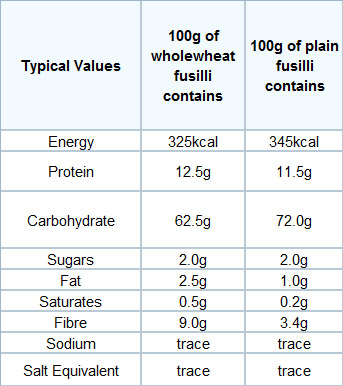
So, brown rice is better than white rice, wholemeal/wholegrain breads are better than white breads, wholewheat pasta is better than the more processed pasta.  Sometimes the differences aren’t huge, but usually they’re noticeable.

But, remember, just because it looks brown doesn’t mean it’s always better for you – some brown bread is often just white bread with something added to change the color, so look for wholemeal and whole grain breads, not just brown bread.  Brown sugar is often just white sugar with molasses added to it, so just don’t put so damn much sugar in your coffee or on top of your healthy Weetabix/Shredded Wheat/muesli/oatmeal/yogurt.

Go for lean protein sources
Probably the leanest sources of proteins (depending on how you cook and eat them) will be vegetable-based proteins like soy beans, legumes, nuts, seeds, pulses and other types of grains (quinoa, for example) not mentioned in the carb section above. Dairy is a pretty good way to get protein, too, with even whole milk only containing 4% fat (watch those fatty cheeses, though).  Tuna is a very lean source of protein, depending on how you eat it (not if it is drenched in mayonnaise in a tuna salad, for example). Chicken and turkey are good, too. Lean cuts of beef, pork and lamb are good, too, and contain other vital nutrients, so don’t interpret all this as me telling you to go and become a vegetarian (or one of those infuriating people who say they’re vegetarian, but eat chicken and fish…?!?!?).  Just look more closely at what you buy. Some sausages, for example are only 45% meat, while others are 85% meat. Some ground beef contains 22% fat (chuck), but some only has 5% fat (sirloin). Read more labels.

Follow the 85% rule
If you are careful about what you eat 85% of the time (say, roughly, 6 days out of every 7), then you can cut yourself some slack the other 15% of the time. Food is enjoyable, food is fun. Every great culture has acknowledged the importance of food in social interaction, celebration and the enjoyment of life. So, enjoy your food, but don’t mindlessly stuff it down until you can’t possibly stuff any more in.  And think about it a little more, but don’t obsess over it all the time, either.

With all these tips here I am certainly not saying that you should be a purist or a health nut.  I think you’ll find that these tips I have given you are mostly common-sense tips, nothing terribly dramatic required of you to follow them and get yourself on the way towards eating well and fueling yourself properly for good exercise and training routines.

Reading Time: 2 minutes

I’ve always marveled at how small retired NBA basketball and now actor John Salley’s ears are. Truth is I have small ears too – not as disproportionate as Mr. Salley’s who at 6’11” has ears the size of nickels, but small nonetheless.

Having small ears was never a big deal back when headphones were worn over the ear, but most headphones today (and Bluetooth headesets) are of the earbud variety and for people like me and JS, keeping earbuds in your ears, particularly when sweaty from working out, is damn near impossible.

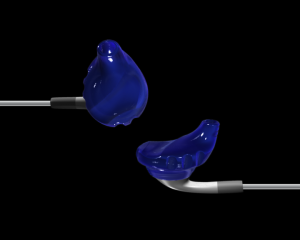
Yurbuds™ have an earbud system that caters to people of all ear types and is specifically designed to keep the earbuds in your ear even through intense physical activity. Yurbuds are two soft rubber ‘boots’ that fit over the provided ‘Apple-style’ earbuds, but can be used with other earbuds or headsets as well. The Yurbud has a small funnel of sorts that fits into your ear canal and the outer-ridge of the Yurbud is grooved, helping them stay in place – even when sweating heavily.

When you order your Yurbuds you submit a picture of quarter placed just below your earlobe. This helps them determine the size of your ear and fit you correctly to Yurbud for your ears. In all my tests of the Yurbuds – running in near 80F+ degree heat for an hour, the Yurbuds never moved and never bothered me. I also got caught in a thundershower on a run (never fun) and again, the Yurbuds hung in there and Mishka kept signing me up the hills and back to my home.

Because Yurbuds are comfortable over long periods of time and stay in place even while sweating, they’re perfect for runners, bikers, and amateur athletes who are looking for a headphone solution you barely even notice.

Priced a very reasonable $29.99, Yurbuds are the perfect solution for anyone looking for headphones that stay in your ears regardless of how much you sweat or for anyone just looking for a more comfortable earbud from prolonged use.

Posted by: Lawrence

Reading Time: 5 minutes

It’s coming up to the 4-week mark after my first iron-distance triathlon and I’ve had a lot of time to reflect on the recovery phase after a big race. 4 weeks feels like about the right amount of time to recover from a long-distance race and get back into training again at some point.  I didn’t do everything I was “supposed” to do these past 4 weeks, but I’ve done a few things right and learned a lot in the process.  It all goes back to some things that I did differently on race day that have helped me to recover quickly…

During the race

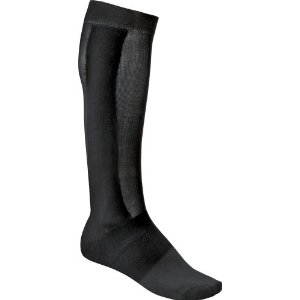
cwx-compression-socksOn the run, I wore compression socks.  I think that made a huge difference (not to my running speed, obviously, as there were snails over-taking me on the run), if only because they helped make sure I didn’t get any blisters that day. I think the nylon “Kinesio-Taping System” or whatever they call it helped keep my feet dry (better than cotton socks ever would have) and my legs well-supported.  WARNING: if you have never worn compression socks before and you wear them with shorts, you WILL look like an idiot, or at the very least like an old man worried about varicose veins.  They are not flattering, you will probably want to crop your legs out of the race photos at the finish line, but I believe it is a small price to pay for stronger, healthier legs.

I also took Endurolyte salt and electrolyte tablets during the run (about one tablet every 30-40 minutes).  They were recommended by a friend who did the same race last year and they seemed to help me avoid any significant cramping on the day. That may also have been due to the excellent support provided by Race New Forest on the run section or the fact that I ended up walking about half the run course, but they sure seemed to help keep me going on the day of the race. I imagine that the dehydration would have been a lot worse without the Endurolyte tablets.

Right after the race
As soon as the race was over, I kept drinking water and sports drinks throughout the rest of the day.  I also started eating as soon as I could (stretching, shower, more stretching, clean clothes, then buffet dinner laid on by the organisers). I kept stretching and drinking water in the car on the drive back to London (about 3 hours). Then, I got a really good night’s sleep and prepared to fly to the US the next day.

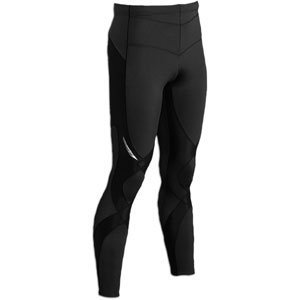
cwx tights When I got up the next day, I put on my CW-X compression tights, underneath my running trousers, to wear on the plane.  And, I gotta tell you, as I walked downstairs to put my bags by the front door and get some breakfast, my legs were INSTANTLY feeling better. I mean, I’ve done dozens and dozens of races over the past decade, triathlons, everything from 5k up to ultra-marathon, and my legs are always aching the day after a challenging event.  But, I have never worn compression tights the day after a race before, and this time my legs felt 90% recovered!!!!!  It was a revelation. It meant that they didn’t hurt very much on the flight going over, I could walk normally, and I felt like I could even start training again that same week.

Walking. That’s always a really good thing, too. Lots of walking. When my legs are tired and aching and sore, sometimes the last thing I feel like doing is anything that involves my legs. Maybe some swimming. Maybe some light cycling around town. But, I usually don’t feel like walking and I certainly don’t feel like running. But, I have discovered that walking can be the best thing for your tired and aching legs after a race. Light but brisk walking. Lots of it. Keep the blood moving, use the muscles in small ways, get the body used to some activity again. Lots of walking.

The weeks after the race
Do as much or as little as you feel you can. Don’t push too hard, avoid higher impact, higher intensity stuff. But, do some exercise and get your blood moving again.  Just don’t over-do it. Remember that most fitness adaptations take place during the Rest and Recovery stage. That’s right, you gain more fitness when you are recovering than when you are doing the actual exercise. While you are resting, your muscles and blood vessels are adapting and growing in new ways to allow you to do even more next time. 

Do you know when your body secretes the highest levels of growth hormones to repair the muscles and make them stronger?  When you are sleeping. So get lots and lots of sleep. My guess is that, in the lead-up to any big event that you have been training for, you probably got less and less sleep as you got more and more excited about the race coming up. So, now is the time to catch up on your sleep.

This is probably where I made my mistakes: I started training again too soon. In my defense, I was running a training camp in the Berkshires for the first time and was very excited about being out there in such beautiful surroundings. So, I got a little carried away and did a lot more training than my body was probably ready for. But, I had a blast and the only real down-side is that I have had another 2 weeks of really excessive tiredness, so I’m taking it easy now. I don’t have another race for another 2 weeks yet, and my next A race isn’t for another month, so I’ll be fine. I’ve just learned the hard way what happens when you get over-eager and return to training too soon (very, very tired, and very, very slow).

Obviously, the amount of recovery time will vary for each person, and you can only listen to your own body to know when you are ready to get back into your normal training routine. Some people need a month to recover from an Olympic distance triathlon (especially their first one), some are back on their feet within days.  Don’t follow any “standard guidelines” and listen to your body.

In the weeks that follow a big challenge, also take the time to reflect on your race results, think about what you did well, what you would like to do better, and how. Get some objective advice on those topics, too. Write a race report, share it with other people, read race reports from other people who did the race, if you can find them. Put it in perspective, savor it, enjoy it, and then move on to the next big challenge.

Reading Time: 7 minutes

Short version:

No official times or splits available yet, so this is what my stopwatch said

  • Swim (probably not the full 3.8k/2.4 mi): 1 hour
  • Transition 1: about 7 minutes
  • Cycle (180k/112 mi): 6 hours 20 min
  • Transition 2: about 12 minutes
  • Run (26.2 miles): about 5 hours 5 minutes

Total: 12 hours 44 min

Someone said they thought I finished in the top 40 out of a field of perhaps 200. So, that’s not bad. I’ll see what the official results are when they put them up. I was disappointed with some aspects of my performance, see that there is a lot of room for improvement next year. But, I enjoyed the race thoroughly and have a lot of respect for racing at this distance.

Long version:
Lovely small event, well organized by the people at Race New Forest (www.racenewforest.co.uk). It is not an official Ironman event (i.e. licensed by the World Triathlon Corporation to use “Ironman” in the event name, or as a qualifier for Kona world championship places), but still a great iron-distance race with a lot going for it.  There were only about 250 signed up to this race (compared to the thousands who might sign up for an official Ironman race), which I think gives a nicer, more local feel to the race than bigger races.  And the organisation was superb all throughout the day, right through to the buffet dinner laid on for all of us at the finish line.

Start

rob popper

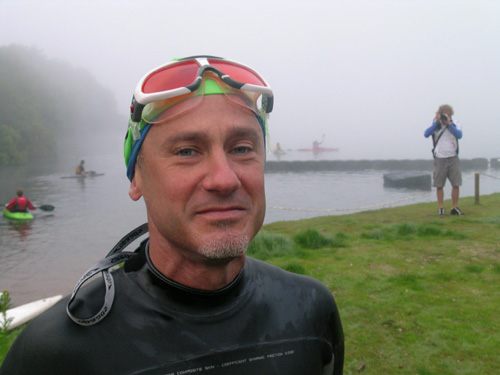
I think that's a mixture of being tired, nervous, and just wanting to get started.

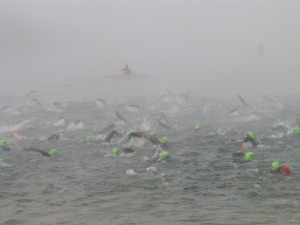
The swim takes place in Ellingham Water Ski  Lake just on the west side if the New Forest, near Ringwood.  3 laps around the lake for a total of 3800m was the plan.  However, the start was delayed by 25 minutes due to very thick mist settling in on the lake and visibility being very poor (literally, not being able to see more than 20 feet in front of you).  The organizers decided to change the swim course to make it 4 smaller laps, bring the buoys closer together so it would be easier to see them through the mist.  They probably shortened the course, in the process, although they said they would make it as close to the full 3800m as possible.

By 5:50 am, we are all slipping into the unbelievably warm and crystal clear waters of the lake. I have never seen lake water so clear and clean. And the temperature of the water made it so relaxing, it was the exact opposite of most early-morning, bracingly cold open water starts I have experienced. It really put me in a good mood and totally relaxed me right from the start.

Swim
Basically, aim for that first buoy over there, the one you can barely see, and then aim for the next one and the next one (which you’ll barely be able to see), then turn right and aim for the next one and then turn right again, then 2 more, then turn right and that’s one lap. Then repeat it 3 more times, and swim straight out to the exit ramp, which you probably won’t be able to see until you are right on top of it, but there should be some kayakers to guide you in.  Huh? What? Which? Where? Oh, whatever.

When you can’t see the marker buoys to make sure you’re on the right course, just follow any other swimmers you can see in front of you and hope they’re heading in the right direction.

Very disorienting, very surreal. It was sometimes easier to see where you were going by looking under the water (see the cables that tie up the buoys from underneath) than by looking above the water.

I settled into a very smooth, very steady style of swimming early on and really enjoyed the whole experience thoroughly. At the end of the first lap, I found someone who seemed to be swimming very straight and at a pace slightly faster than mine, so I got on his toes (drafting off of a swimmer in front of you is sort of like drafting on a bike, in that you can get pulled along in their slipstream and go at their pace with less effort) and stayed there for 2 laps.  Lovely!

I came out of the water bang on the 1 hour mark, which must mean that the swim was shortened significantly. 1 hour 15 minutes was my target time, and I am pretty sure I didn’t swim that much faster on the day.

T1
Sandy transition area, taking my time trying to dry off my feet, get some socks on, cram some spare tubular tires into the back of my trisuit. Oh, yeah, don’t forget the Endurolyte salt and mineral tablets Kev recommended! And sun cream, put on lots of sun cream. Okay, enough faffing, off I go!

Bike

Didn’t get a chance to check out the course the day before. Usually a big mistake not to check out the course. Usually means that I will go around the first lap, feeling my way around, unsure of how to pace myself, trying to hold something back for the other 2 laps of the course to follow, but still somehow get the pacing wrong. Yes, that’s pretty much what happened.

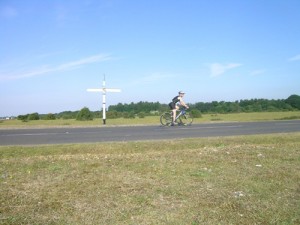
I found the two biggest challenges of the bike ride to be boredom and discomfort.  A small race like this means that you will rarely see other cyclists as you cover 112 miles of road, going round and round and round the New Forest. Not like going for a long ride with Kev, Roz, Lance, Avi, Guido, Naomi or Becky and having someone to chat with. I also learned that my tri-suit didn’t really have enough seat padding to keep my butt from getting sore on the ride, and I probably should have worn some proper cycling shorts.

I had hoped to complete the bike course in under 6 hours, but wasn’t too upset with about 6:20 on the bike. Note to self: always check out the course before the race and wear proper cycling shorts next time. Also, find ways to cope with boredom, or else do shorter races next year.

T2
Cycle into Sandy Balls Holiday Village (I kid you not), dismount, run with the bike into a new racking area, and then run into the changing tent where I pick  up my run kit (they give everyone a separate bag that is marked and waiting for you, since the transitions take place in two different places). Sit down in a chair and get fanned by some volunteers. Very nice, chatty, relaxed, friendly. Volunteer reminds me to put lots of sun cream on my shoulders and I missed a spot on the back of my neck. Pull on the compression socks and joke with the others that we have 8 hours to get around the course before we have to be worried about the cut-off time, so it should be an easy run today! Hah! Yeah, right!

Run
I could go on and on about the run, but I won’t. I’ve probably gone on and on in this report enough already. The run was brutal. It was mostly a trail run along sandy, dusty, gravely, hilly, exposed terrain. The weather was hot, there was not a cloud in the sky, and at least half the trail had  no tree cover.  It took me a little over 5 hours to run this marathon. I can usually run a marathon in 3.5 hours, and I have done a fair amount of trail running and races this past year, so I did not think it would be this tough.

In some races, there is a point where you see your targeted, ideal finishing time disappear from sight. You try to bargain with the targeted time, like, “If I can just dig a little deeper and pick up the pace again, get some inspiration from somewhere, then maybe I could make it.”  Then, you re-set your sights on some new targets, like, “Okay, 12 hours is out of the question, but you can still stay under the 13-hour mark.”  Then, sometimes, you reach another point, a slightly more dangerous point (from the view of racing performance), but a much more liberating point, where you say, “You know what? Just get me across the finish line in one piece. Don’t let my daughter see me crawling, crying, or stumbling into the medical tent to be hooked to an IV.”

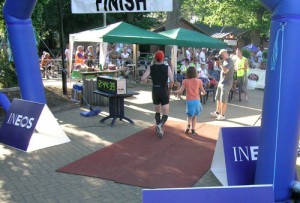
And, so I finished the trail run on just over 5 hours, and ran slowly but steadily to the finish line. My daughter jumped over the barrier at the end, took my hand and ran with me across the finish line. THAT was the highlight of my day!

Epilogue

It is the next day and I often judge my race-day performance, on how quickly I can recover. I have a family, work commitments, travel plans and a life to get on with. Triathlon training and racing is important to me, but the other things in my life, ultimately, are more important.  When my daughter says to me, “Dad, am I going to be late to school because you’re hobbling around, walking like an arthritic turtle, after your latest marathon/ultra-marathon/triathlon?” it reminds me that I have a responsibility to the people I love, and life goes on when the race is over.

Today, I feel surprisingly good. My legs were really killing me yesterday and I thought I might be hobbling around for a week or so. But (largely thanks to my CW-X compression tights) today, I am feeling pretty good and walking almost normally. And, Ella got to school on time this morning! Much more important to me than finishing under 12 hours.

Reading Time: 5 minutes

Swimming

The sound of zipping up your wetsuit early in the morning.

The small ripples you make in the water when you get in. The splashes other people make when they get in.

They squeal and make high-pitched noises, but you have done this so many times before in much colder conditions, you just sink into it quietly and don’t make much noise. Warm up slowly, get the blood moving gradually.

The even steady rhythm of hands entering the water, good catch at the front, full stroke all the way through, relaxed hand and high elbow recovers to the front.

There is a tiny drip-drop sound that droplets of water make as they drip off your hand when it recovers back to the front and then you smoothly, purposefully place your hand back in the water.

Your legs don’t make much noise when you kick steadily and smoothly. It’s more like a percussive beat in the background.

The sound of your breathing, quick strong inhale, slow steady exhale.

Your ears might be covered by your swim cap(s) and you are cut off from the rest of the world.

Consistent breathing every 3 strokes, sometimes every 4 or 5 or 6 or 7 strokes.  At the very beginning and at the very end, maybe every 2 strokes.

Your heart beating in your ears. The hands, legs, breathing, heart all fall into synch with each other.
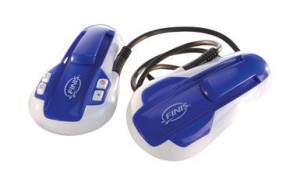
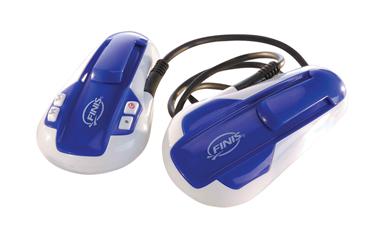
How is it that people get bored when they are swimming? How is it that they say they don’t have enough to occupy their minds and ears?  As cool a gadget as it seems, I can’t imagine wanting to get the Finis SwiMP3 player, myself.  There is more than enough for me to listen to. Maybe when I start swimming more than 5k I’ll think differently…

Cycling
Cycling shoes clicking into pedals. When you can do it without looking down, when you know the feel of the shoes and the pedals and you’ve done it 100 times before and all you need to do is listen for the right sort of click sound. (There is a wrong sort of click sound that sounds like the right sort of click, but isn’t exactly the same.)

The sound of fully inflated tires against smooth pavement. Whizzzzzzz along early in the morning, going off to meet some friends for a long ride, or maybe just head off on your own.

The clean, well-oiled chain as it zips around the rear cassette up towards the front chainring and back around through the rear derailleur.  Smooth and nearly silent. When the morning is quiet enough and the streets are empty enough, you can hear it.

The clacking-buzzing sound of the freewheel, when you stop pedaling and the back wheel keeps spinning and it makes that sound of freewheeling.

The steadier, slower rhythm of pedaling uphill. Move the bike, not the body, keep driving down and all the way around on the pedals. Steady, maybe slightly uneven rhythms. But it’s your rhythm, and when you feel good, you own that rhythm.

Up out of the seat and harder on the pedals, picking up the pace on the hills and pushing a little faster.

The sound of your breathing getting heavier on the hills. Most of the time you don’t notice the sound of your breathing, not like you do when swimming or running. But, on the hills you notice.

You don’t need to look at your heart rate monitor to know how hard you’re pushing, how much longer you can hold it like that. When you’ve done it 100 times before, you just know. And sometimes you push harder, sometimes you hold something back for later. It’s your rhythm, your choice.

When you go really fast downhill and stop pedaling, you probably can’t hear it any more. The wind is rushing through your ears, your helmet, your clothing so fast that all you hear is fast-moving air.

You take a drink on the downhill and re-fuel for whatever comes next. The sound of a bottle that is almost empty, liquid sloshing around audibly. Needs to be switched with another bottle you brought or one you’ll get at an aid station.

Brakes touching the rims. Slowing down slowly, steadily or abruptly.  Metal rims sound different than carbon rims.

You can hear when your brake pads are getting too worn out, feel when the cables need a little tightening.

You can hear when your wheels aren’t true and the spokes need tightening.

You can hear when the brakes aren’t in perfect alignment.

You can hear when the derailleur needs a little adjustment.

You can hear when cars are approaching from behind.

You can hear around corners, sometimes, approaching cars from the sides or up ahead.

Not always, but sometimes you can hear another cyclist come up behind you.
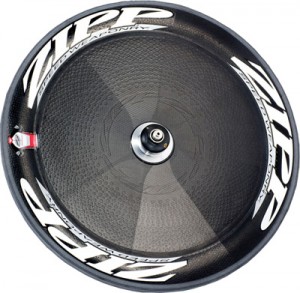
Those guys with the disk wheel on the back, you can hear them coming a mile away. It’s like a noise Darth Vader would make if he were riding a bike, like some hellish, basso profundo, voof-voof-voof sound that is coming to get you and you are helpless to escape.

Who on earth would want to listen to music on a bicycle?  There is so much to listen to, to listen out for.

Well, maybe on the turbo trainer. Yes, I will admit to making playlists and listening to music when stationary. But, never when I’m out on the road.

Running
Pulling on compression socks, for a longer run, strapping on a heart rate monitor or a GPS to tell you how far, how fast, how hard. Small sounds, maybe the occasional electronic beep to tell you something is activated or there’s an error message.

I can understand people wanting to listen to music while running. Most people seem to run because they feel they HAVE to run – maybe it’s the cheapest, easiest way they can think of to lose weight or stay in shape. But, if you LOVE running, then it’s different. There’s plenty to listen to without music in your ears.

The sound of your feet hitting the ground. You can tell a lot from the sound your feet make, if you listen out for it. Pronation, supination, heel strike, fore-foot strike, strong ankles, wobbly ankles, short stride, long stride.

The surface you run on makes a big difference, too. The relative flat sound of running on streets, up and down sidewalks. The gravelly sound of running on paths. The crinkling, crunching sound of leaves and twigs and grass on a trail.

Your breathing is much more pronounced when running. Your heart rate will probably be more elevated than in the other two sections.

You can hear it more in your ears, feel it more in your whole body, your breathing, your heart pounding.  It’s more like it was on the swim, but now the sounds from all around you are part of it, too.

Early in the morning, you can tell the changing of the seasons, predict the weather for the rest of the day by listening to the birds around you, even in the densest most crowded cities.

Need to listen out for cars, too. Hybrid cars have the unfortunate distinction of being the toughest to hear coming, so you need to be specially careful about them.

There’s always music playing in my head. Not full songs, but usually my favorite bits that I keep playing over and over again.

The bass intro to “Superstition” by Stevie Wonder, up until “Very superstitious writing’s on the wall.”

The intro to “Back To Life” by Soul II Soul, up to “Back to life, back to reality.”

The chorus of “Sex on Fire” by Kings of Leon, as well as the line “Hot as a fever, rattling bones.”

Who knows what will play in my head next time. Something I heard on the radio this morning, something I heard 25 years ago at Danceteria (“A E A E I O U U, and sometimes Y-ii”? oh, no!), something my daughter played over and over again last week (“promise I made, promise I made, started to fade, started to fade”? hmm, okay…). I know I can’t sing worth a damn. But it always sounds great in my head.


Reading Time: 3 minutes

As a triathlete, you kind of have to get used to early mornings. Most races will start pretty early, and you’ll probably find you have to get up at ridiculously early times to get to the races on time (but, like, how do you get a decent night’s sleep when you have to get up at 2am for a race?). It’s also generally a good idea to try and fit in your longer training sessions early in the day, so you get it out of the way and still have time for the other people/things in your life.

On top of that, as a triathlon coach, I am still getting used to the fact that people mostly want to be coached either very early in the morning or later in the evening.   Getting up at 4-4:30am 3 days a week so I can do my job still takes a lot out of me, especially when you add 20 minutes up to 1.5 hours travel time each way to coach these sessions.  But, it’s still my favorite time of the day.

I know it’s not just a triathlon thing, I know lots of people like to get up early to catch the good waves, the fresh powder, the greens that have not been trampled.  But, here are some of my observations and meditations:

  • I LOVE riding around the streets of a big sprawling city like London or Chicago or Beijing when they are empty and you feel like you own the place or you are the star of post-apocalyptic movie (without the zombies or robots)
  • Foxes live in a lot of the parks in London, and the only time you will see them is in the very early hours of the morning , and they are surprisingly shy and tame-looking

  • The sight of rabbits darting into the hedges, scurrying across a field, or just plain running away as you approach is probably THE most enchanting sight I have ever seen
  • Geese and swans, however, can be vicious bastards if disturbed in the middle of their early morning rituals
  • There are still a surprising number of electric milk floats working all over London
  • People who get up and go to work in the early hours of the morning tend to be the most chilled out and approachable people, everywhere I have ever been (US, Europe and Asia)
  • Getting up early in the winter time, on a dark and cold morning, is especially awesome, because even fewer people do it, and you feel like you belong to a very elite club

  • If you are not a fan of sun-rises, it’s probably because you haven’t experienced enough of them, so force yourself to get up and out that early some time and you might just surprise yourself with how much you enjoy it
  • I like to be reminded that once I was the sort of person who stayed up until 5:30am and then came home from fantastic nights out, and now I am seeing it from a different side

I guess that’s the part I like the best about 5:30am: the chance to see things from a very different perspective, maybe surprise yourself, maybe experience something really unique. While you avoid the broken glass and drunk drivers.

Please feel free to add your comments and meditations below.

Reading Time: 3 minutes

Okay, confession time!  I don’t know much about fetishes, but I think I have developed a wetsuit fetish.

One of the things I love about doing triathlons is wearing wetsuits. I love open-water swimming, anyway, with or without a wetsuit. I am a Pisces and maybe that has something to do with it. But, with a wetsuit, you get more buoyancy (so you have to do less work to stay afloat), get more streamlined (so you fight the water less) and basically I swim at least 10% faster when I wear a wetsuit.

But, it’s more than that.  Without trying to change the tone of this wonderful, gadget-obsessed, slightly geeky blog, I am going to go out on a limb and say that I think wetsuits are sexy. Not sexy in any kind of immediately obvious way (you know, all wrapped up in black neoprene and stuff), but sexy in the sense of making you feel more powerful, more capable, more like…well, a superhero or something.
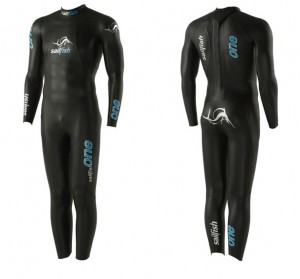
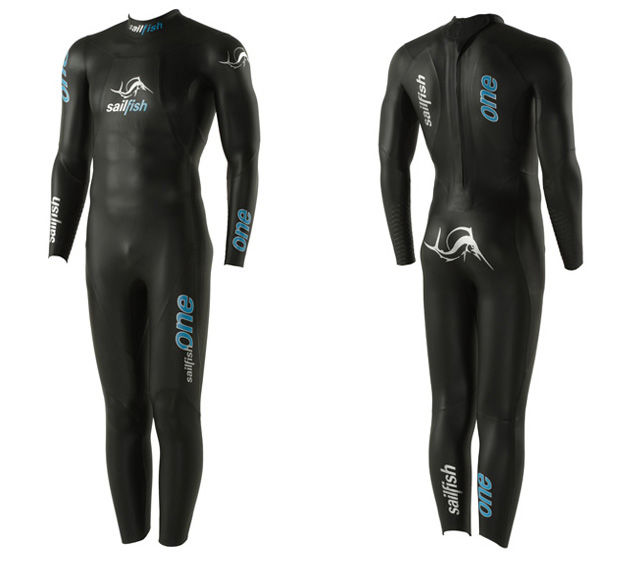
Tell me you don’t think you would swim faster, look cooler and generally feel more sexy in that Sailfish One over there. Am I right or am I right?  Maybe I’m totally crazy and it’s time for me to get a new hobby. But, if I’m crazy, then why did they put that Sailfish graphic on the butt?  Just answer met that.

As a coach with Swim for Tri, I am lucky enough to have been given some awesome deals on some awesome wetsuits. And, this year we are sponsored by Speedo, so we have been given a pretty nice range of Speedo wetsuits to try out. I have tried (and loved) the Speedo STR Pro, which is probably the best-fitting wetsuit I have ever worn.  I am looking forward to wearing it in my races this summer, and I am counting on it (and it alone, without needing to do any more serious swim training) to make me swim faster than I have ever swum before.

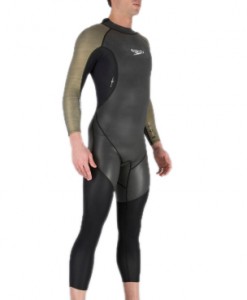
And then, the other day, I had a revelation. I tried the Speedo Thinswim wetsuit when I was coaching at a swimming pool early one morning. I had encouraged everyone to bring their wetsuits to the pool so that we could talk about putting them on, taking them off, and how they change your front crawl technique. I brought the Thinswim because I didn’t want to be wearing a wetsuit of normal thickness (Thinswim is about 1mm thick whereas most wetsuits are about 3-5mm thick) all morning and get dehydrated while I was coaching.  But, here’s the revelation: once I got the Thinswim wetsuit on, I did not want to take it off.
Forget about the fact that it is not nearly as buoyant as the other, thicker wetsuits, and it probably won’t make you go as fast as a normal, thick wetsuit. Forget about the fact that it is harder to get the Thinswim on because the material is so much thinner and harder to pull on (especially in the arms). Forget about the fact that the thinner material leaves NOTHING to the imagination, and everyone will know what religion you practice.  I wore it for 4 hours the other day and honestly wanted to keep wearing it all day long.

It makes me want to swim around the world, if only to have an excuse to keep wearing the Thinswim for months at a time.  So, that’s gotta be a good thing, right?

Even as I type this, I am debating the pro’s and con’s of stuffing it in my backpack as I set off for the Alresford Music Festival, just on the outside chance that I get a chance to wear it at some point this weekend  – a weekend which, I might add, my daughter has banned me from all triathlon-related activities.

So, just to finish off the sordid picture I have drawn for you, I have been reduced to sneaking around behind people’s backs so that I can get a few minutes of sheer multi-sensory delight with the Thinswim.   Maybe it will rain really heavily and it will make perfect sense for me to walk around in a wetsuit.  Maybe there are worse things to be obsessed with.

Reading Time: 3 minutes

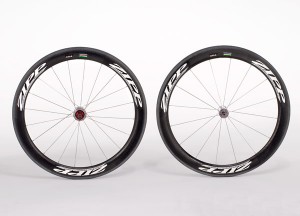
In a moment of weakness, I put in a bid on eBay for a set of Zipp 440 carbon fiber tubular tires a few months ago. A new set of those wheels, the Zipp 404 tubulars, cost at least $1,500 for the pair (and that’s without skewers, cassette, tape and tires), and there was a pair for sale at about $500, with tires and cassette.

zipp 440

As I got caught up in the heat of eBay bidding, I also undertook a crash course in tubular carbon fiber wheels to see what I was getting myself into. Here are the pluses I learned about:

  • obviously, carbon fiber wheels are lighter and stiffer than aluminum or alloy wheels, so they’re faster
  • tubular tires are glued to the rim, rather than held on by the metal “hooks” of clincher tires, so tubular wheels are lighter than clincher wheels
  • tubular tires are much higher pressure (150-200 psi versus 80-120 psi) and so can be much faster, thinner tires than clinchers
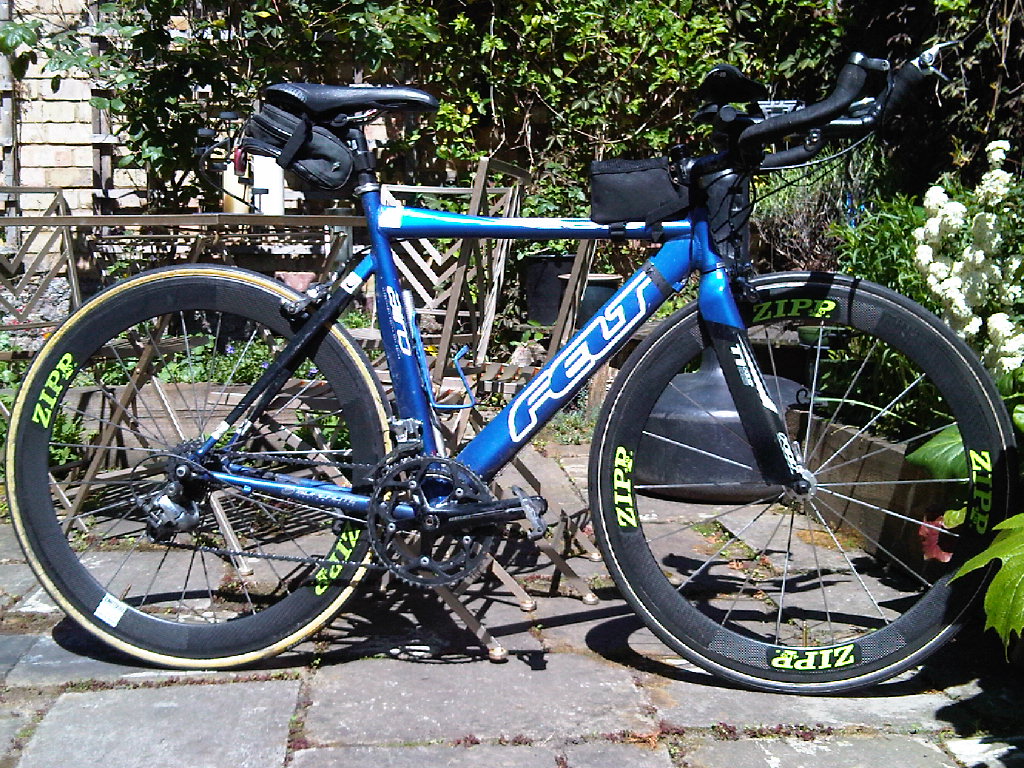
  • Zipp carbon fiber wheels like these make pretty much any bike look totally awesome

My baby, with aforementioned Zipp 44o's

Well, needless to say, I won the bidding war and became proud owner of a set of Zipp 440’s and then quickly learned some of the minuses of owning these wheels:

  • you need special, compressed-cork brake pads for carbon fiber wheels (unless they have an aluminim strip around the outside) because your regular rubber brake pads will damage the carbon fiber rims, so that’s an extra cost there of about $20
  • you may not be able to fit your normal accessories on your new wheels (speedometer sensors, etc) since the spokes and wheel shape will probably be very different on these wheels, so that’s a pain
  • flat tires with tubulars are VERY expensive and a major pain in the ass – you can’t just whip off the tire, stick in a new inner tube, pump it back up and then head off like you can with clinchers; you have to peel the tire off the rim, re-glue a new one on and work it back on by hand (DO NOT ever try to use tire levers on a carbon wheel, unless you want to destroy them)
  • you can’t use a hand-held portable pump to get enough air into tubular tires when you re-inflate them (maybe only for very short emergency purposes, but 80-90 psi from a hand-held pump just won’t cut it on 150-200 psi tires), so you end up carrying around lots of expensive little CO2 cartridges to inflate tires on the go
  • you can buy repair kits for tubular tires, if you want to spend an entire day unstitching the sewing, repairing and replacing the inner tube and then re-stitching the tires back together again – OR you can throw away the flat tire and replace it with a new one – new tubular tires cost about $40 to $120 … EACH
  • yup, that’s right! every time you get a flat you are talking about a minimum of $40 for a new tire, maybe $5 worth of rim tape and another $5 for a CO2 cartridge – compare that to fixing a flat on your clinchers with a new $7 inner tube

On my first 4 rides on these new wheels, I got 4 flat tires. The costs mounted up quickly and I started to panic. It was costing me about $60-70 every time I went out for a ride, and it was seriously taking the fun out of these sleek, fast, sexy new wheels.  I began to look at my old aluminum clincher wheels and think that maybe I had made a horrible mistake and needed to go back.

But, I didn’t. I stuck it out. I did several more long rides on the 440’s and didn’t get any more flats. I ride around now, with 2 spare tubular tires in my back pocket, a roll of tub tape, and about 4 CO2 cartridges, ready to deal with flat tires if and when they come along.  But, touch wood, it hasn’t happened for the past 5 rides.

And these wheels are awesome. I am noticeably faster on all gradients, sharper around the corners, and I am having significantly more fun than I was at this time last year.

So, my verdict: I love these wheels. I am going to keep them. I am having sooooo much fun with these wheels.  They are more expensive to own and maintain, they are more hassle to fix, they require more time and attention than my old wheels. But they are soooooo worth it.

Posted by: Robert

Reading Time: 5 minutes

Sorry for the long silence. Been away for a while, getting stuck into my big challenge this year: training for my first ironman triathlon (the Forestman).

For those of you who didn’t know (and if you already knew this, then please allow me to try and impress you once more with the sheer numbers), an ironman triathlon involves 3.8 km (2.4 mi) of swimming, 180 km (112 mi) of cycling, and 42.2 km (26.2 mi) of running, all in one continuous event, with the clock running the whole time.  A guy like me (45 years old, been doing triathlon for about 8 years now, training pretty regularly, but not winning any medals in any races) will do about 75-85 minutes of swimming, about 6-6.5 hours of cycling and 4-4.5 hours or running at the end of it all.  The top guys will routinely finish in under 10 hours, bless ’em. But, I’ll probably be looking at something closer to 13 hours (gotta include time in transition between events, since the clock is always running, and it makes sense to take 10-15 min to dry off and put some clean socks on before you set off for a 6-hour cycle ride, rather than rush through it and be uncomfortable or getting blisters for the next 6 hours). Most courses will have about a 17-hour cut-off point after which they have to clear the course of anyone who hasn’t finished by sun-down.

Tapering
My race is about 2 weeks away now, so I am officially in the “taper” phase of training, which means I am doing fewer and fewer hours of training each week (at my peak, I was doing about 15-20 hours each week, now I am down to about 10-12 hours a week), so that I get to race day feeling fresh and well-rested. But, at the same time, I am trying to keep the intensity of each session quite high, so that I keep my fitness levels and sharpness high for the day of the race. But, it has also given me more time to step back and reflect on what I have been doing this year, think about the training I have done so far, and what factors have contributed to getting me this far.

Milestones and motivation
Some ups, some downs, and some key milestones along the way. It helps to have some carefully targeted events to measure your progress and keep you motivated along the way, such as:

  • Back in early April, I did a 5k Swimathon for charity, which was an excellent exercise in settling into a good steady pace for 102 minutes of non-stop swimming. And it gave me a lot of confidence to know that I could swim way more than the 3.8k I’d need to swim in an Ironman. Of course, at the Swimathon, I swam next to Dan Bullock, one of Britain’s fastest veteran swimmers, which was simultaneously humbling and inspiring. He finished in about 62 minutes, or 40% faster than I did.
  • A few weeks later, I got offered a last-minute spot in the London Marathon, and I managed to get around in 3 hours and 28 minutes, which I was very pleased with.
  • Lots and lots of long cycle rides with fellow triathlon club members, including one super-gorgeous, super-tough day of about 130 miles trying to keep up with some incredibly fast, ridiculously tall guys 10 and 20 years younger than me.  Again, humbling and inspiring seems to be the theme to my training this year.
  • Joined a relay team to swim across the English Channel to raise money for charity, later on in September. That has given me something to look forward to once the Forestman is over (and lots of people tell me about the post-ironman blues, that anticlimactic feeling that sets in after achieving such a big goal as this).

And, I’ve learned a few valuable lessons along the way, about myself and about some of the people in the triathlon community around me…

  • Given half a chance, your typical triathlete who trains for ironman-distance races, will become obsessed.  I mean, if you are an amateur athlete then trying to find 15-20 hours a week in which to do all your training, you kind of have to be obsessed. It helps that I am a triathlon coach and so some of my training gets done in the course of working. But, family, friends, holidays, working schedules, sleeping routines, meal times, and your favorite TV shows will all end up taking a back seat to this all-consuming passion.  There’s no way to sugar-coat it: I have seen my fair share of marital strife, disappointed friends, and unhappy kids this year and some parts of my life are in worse shape than they were before I started this.  Has it been worth it? Ask me in a few weeks.
  • We also can be very boring companions, we iron-distance triathletes.  There are times that the only people who want to be around me are other triathletes, especially those who are also doing iron-distance training. I typically run out of small talk within 15-20 minutes and eventually resort to ironman-related conversation, pretty much wherever I go, whatever I do.  I have been known to recommend to 20-something fashion models that they eat sports gels and drink sports drinks, instead of resorting to their natural diet of coffee and cigarettes, in order to get through their rigorous schedules.  So “bored incomprehension” is the look I am getting used to seeing a lot more these days.
  • And, when we’re not training, we’re recovering from training, or we’re eating everything in sight, or we’re going to bed early to get ready for the next training session.  So, in the other hours of the day that we’re not training, it still is all about the training.
  • Once you give in to the obsession, get used to the unsociable hours, and accept the fact that all of your friends and family have given up on you, it really isn’t so bad. If you’re lucky enough to find some other people to train with, then you can all motivate each other and commiserate with each other. But, the actual training itself is really not that tough. You will go slower than you would normally go for shorter distance training, and you just have to stick it out for a lot longer. Boredom is probably the toughest part of an 8-hour training ride or a 4-hour training run.
  • You can probably eat anything you want while you are training for iron-distance races, and you will still probably lose weight. Not that you should subsist entirely on ice cream and coke, but you probably will have to consume a huge number of calories to get your body back in balance when you get back from an 8-hour training ride. If you choose to consume 2000 kcal of salad and whole grains, that is great! If you choose to consume 2000 kcal of  burgers, fries and ice cream, then that ain’t so bad, either.
  • It’s worth saying one more time that without the support and camaraderie of my friends at Tri London, I would not have made it through that tough, freezing winter with so many useful hours of training under my belt.  Whatever I do at the race on June 27 will be almost entirely due to the support of people like Kev, Roz, Lance, Guido, Andrew and Stephen, dragging me around Southern England at 6am almost every Saturday, and waiting for me at the end of every hilly climb.

Still feels like a long way to go, and maybe longer still once I sign up to do it all over again next year.

Posted by: Robert