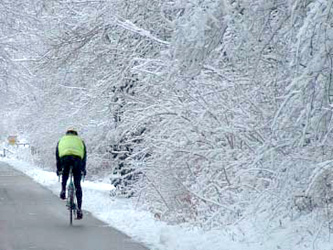
Reading Time: 9 minutes Okay, it’s cold and dark and wet out there, if you’re living in the northern hemisphere and it’s what we call Winter time (not that bullshit they complain about in Florida when they have to put on a sweater or something). You don’t want to ride your bike, you don’t think it’s safe out there, you don’t want to get up early in the morning before the sun is up, and you have a hundred excuses to stay warm and cozy in bed. I get it. That’s me, too, on most days.
This is the toughest and possibly the most dangerous time of the year to fit those long rides in. But this is also exactly the time of year when you most need to fit in those long rides. You need to build aerobic endurance right now, so you have that strong base to build on later. That means keeping the intensity low and steady while building up the miles gradually until you are over-achieving your target race distances (maybe not for running, though, because of the higher impact and greater risk of injury) in your aerobic endurance heart rate/intensity zone.
If you are a triathlete, then cycling is probably the most time-consuming discipline to train for of the three, since it tends to be the most time-consuming discipline in any race – unless, for example, you are a really, really fast cyclist and a really, really slow runner. For your longer endurance sessions that probably form your key sessions each week, time spent on the bike can be as much as 2-3 times the time spent running and 5-6 times the time spent swimming. For example, if you are training for Iron-distance races, then you might want to build up to doing:
- about a 90-minute endurance session each week, gradually getting to the point where you can swim 4000 meters continuously;
- one long steady distance (LSD) run somewhere around 2-4 hours each week, where you can run about 20 miles steadily and continuously;
- one long ride of 8-10 hours each week. Yes, 8-10 hours. Build up to the point where you can cycle about 120 miles on a single ride. At aerobic endurance pace, that means you might not go much faster than 13-15mph.
Not starting right away, not proving how tough and macho you are, when yesterday you were doing 5-mile runs and 25-mile bike rides and tomorrow you’re going to tag along for a 20-mile run or a 100-mile ride. Building up to these steadily and gradually with about 10% increase in volume each week so that, come race season, you have slowly adapted to these longer distances and hopefully avoided injury or burn-out or both. But, you can see how the cycling part of that picture is the toughest to fit into a schedule that may already include work, sleep, a social life, and a significant other in your life who likes to spend time with you when you’re not snoring or wolfing down food in between training sessions.
So, Winter tends to be a time you need to get creative, add some variety, and find every possible way to get in the training on the bike. Here are a few tips that have been working for me, so far:
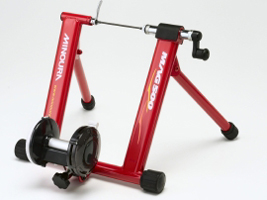
Get a turbo trainer
There are a few great things about turbo trainers:
- They don’t have to be outrageously expensive. The Minoura Mag 500, pictured left, is a very good entry-level trainer I bought on sale a few years ago, and I saw one on eBay the other day for less than $100.
- You attach your bike, via the skewers on the rear wheel, and spin away indoors, in the warmth, safety and comfort of your own home (or in the relative safety and comfort of the back garden, in my case) as long as you want, any time of the day or night.
- You get to spend more time on your own bike, adjusting and getting used to the set-up on your bike for optimum performance (e.g. so much easier to get the saddle position just right when you are using a turbo trainer). You can try new things out (like the first time you buy clipless pedals and need to practice clicking in and out, or the feeling of being on your new aero bars) on the turbo in relative safety before you take it out on the road.
- You can do interval sessions with pretty precise control in a way that you can’t always get on the open road. For example, if you are on the road in the middle of a 3-minute higher-intensity interval and you reach a busy intersection with a stop sign, then you have to stop, whether you’ve finished the interval or not. You won’t have that problem on a turbo trainer.
- You can do many technical exercises and drills on a turbo that you might not be able to do on your bike on the road, like single-leg exercises or hands-free exercises.
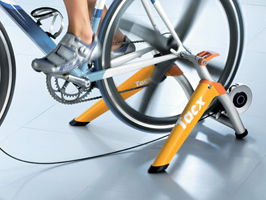
- Some people love to sit and spin on their turbo trainer for hours and hours, watching TV or listening to music. You can even buy some DVDs that connect to your turbo trainer in a cool sort of virtual reality kind of way (if you buy a pretty high-end one, like the Tacx Satori pictured above, right).
The down-sides of having a turbo trainer, that I’ve seen so far:
- I find them excruciatingly dull, in much the same way that I find running on a treadmill excruciatingly dull. I enjoy cycling and running because I enjoy getting out and about and seeing things, exploring places, even familiar places, at different times of the year. I can’t, for the life of me, find a way to spend more than 60 minutes on a turbo trainer without feeling like a hamster on one of those exercise wheels, going absolutely nowhere in pointless repetition.
- You won’t learn much in the way of bike handling skills on a turbo trainer. You may be getting very fit on the turbo and it may be a great way to tackle specific fitness development, but you won’t be learning anything about braking, cornering, ascending or descending on the bike. Triathletes already have enough handicaps in their bike-handling skills, especially if you are only doing non-drafting races or if you spend a lot of time on the aero-bars. We need to get out on the road and ride for real as much as we can to get those very important bike-handling skills.
- You will sweat like a pig in a steam room on the turbo. When you are cycling out on the road, the air rushing past you tends to dry you off as you sweat, most of the time. When you are cycling on the turbo, there is no air rushing past you since you are sitting still, and you are going to create an enormous pool of sweat beneath you very quickly. Even in the middle of January sitting out in your unheated back garden. So, put something under your body to catch all that sweat.
Go off-road
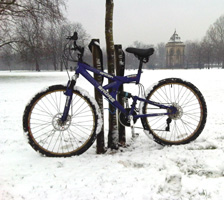
When snow and ice become an issue on the roads in the Winter, then think about going off-road. I bought that bike pictured above second-hand for less than $100, cleaned it up, changed all the cables and pads, plus a new chain and cassette, for a total of another $100 or so, and now I can ride all over the place, whatever the weather. London is not used to seeing much snow in the Winter-time and so it tends to freak people out here, but not me. For me, it means that the streets are less congested and I still get to cycle all over the place.
Here are the things that I like about riding my mountain bike at this time of year:
- It’s much heavier, clunkier and much less efficient than my road bike or my TT bike. Yes, I think that’s a good thing, because it makes my legs stronger. With the front and rear suspension on that monster, I estimate (with no scientific basis whatsoever) that every mile I ride on that bike is like riding 2 miles on my sleek, efficient TT bike.
- I can go places on that bike that I can’t go on my road bike. I can get out there and just have fun, go exploring and play in the mud.
- Off-road riding tends to give you much better bike handling skills in many areas than road riding does. Having to negotiate puddles, icy patches, trees, tree roots, ditches, leaves and all manner of fun obstacles is a great way to learn how to handle your bike. Come Spring-time, I will be much less scared of puddles, wet leaves, and unevenly paved corners on the road.
- I live near a part of London that is good for off-road riding (Hackney and Walthamstow Marshes along the Grand Union Canal is fairly flat but lots of little places to go off the beaten path and splash around), and not too far from some even better spots for off-road riding (all around Epping Forest). So, it’s easy for me, maybe not so easy for other city dwellers.
See and be seen
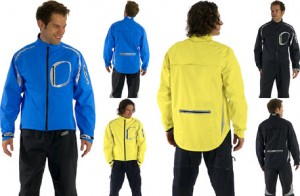
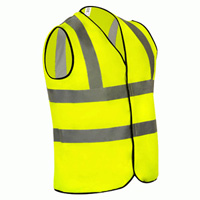
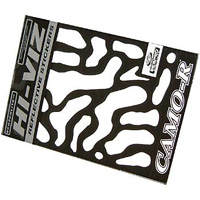
Be safe, be seen. Wear things that are bright and reflective, invest in some good lights, maybe a few lights that will help you see on a totally pitch black morning, but definitely some lights that will make people look at you and notice you. And make sure you have spare, fresh batteries for them.
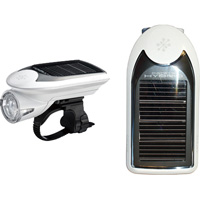
Above is the Cateye Hybrid, which has a solar panel that claims to give you 6 hours of ride time (so that probably means 2 hours to you and me, in real practical terms) and batteries for up to 30 hours (claims like these usually fall short). I haven’t tried this one out, but I’d love to. I love the idea of anything that is solar-powered.
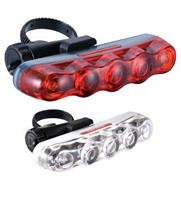
Above, you have the basic Cateye pair of lights for urban-noticeability. I like these because they have lots of blinking settings, they are a little bit bigger than other typical bike lights, and they can be set up either vertically or horizontally, which is kind of cool.
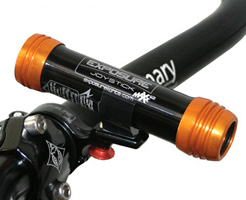
Another choice is the Exposure Joystick Maxx light, that comes with a helmet mount and handle-bar mount. I like the helmet mount because then I can use that light on any bike I ride (I have 3 right now) and don’t have to re-mount it on different handlebars if I use a different bike.
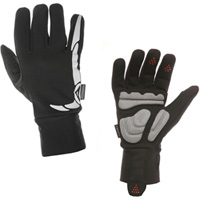
Stay warm and dry
- Gloves should be keeping your hands warm and dry, and have some padding specifically for cycling if you plan on being on the bike for a long ride.
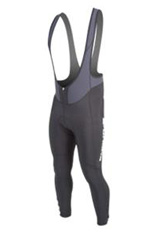
- Tights should keep you warm and probably be bib tights like those shown above, so they don’t creep down while you are riding.
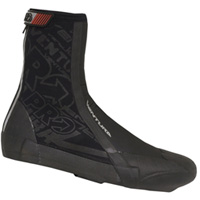
- Overshoes should keep your feet warm and dry, too.
It’s also a good idea to have a helmet cap to keep your head warm.
On very cold days, I will go as far as the wear under-gloves or a second pair of gloves under my winter gloves, as well as a face mask (or just tie a bandana around my face) to protect the one part of my body that is still exposed.
I once forgot to bring my overshoes on a long ride, so I stopped in at a shop and asked for two plastic shopping bags. Then, I took my feet out of my cycling shoes, put the bags around my feet and then put the shoes back on. Presto! A cheap way to keep the feet warm. They got very sweaty, looked ridiculous, were not very comfortable, but my feet sure stayed warm.
Sometimes the hard work is its own reward
Join a club, find a friend with similar goals to yours, or just somehow find a way to make a promise to someone else that you will do the ride, and then you may find it’s so much more difficult to change your mind and back out at the last minute. Try something new. Get out there and ride when you can.
Make a list of things you like about riding in the Winter and put the list next to your bed. When the alarm goes off and it is still dark and cold and you feel like rolling over and going back to sleep, read the list first. My list of what I like about riding in the Winter looks like this:
- I get to see the sun rise.
- I get to ride the streets when they are pretty quiet.
- I get to see things I normally wouldn’t get to see, like foxes, milkmen driving electric milk floats, and people wearing glittery party clothes as they stumble around the streets.
- I get to drink as much hot chocolate as I like and never once worry about calories or fat or sugar.
- I get to ride with some pretty cool people, chat with them for hours, and get to know them a little better. Sometimes I don’t feel like I am boring them to death with all my long-winded stories.
- The journey is the destination. I love being out there on my bike, any time of the year, and it is always better to be out there than to not be out there wishing I had done it.
Posted by: Robert