Reading Time: 7 minutes

Short version:

No official times or splits available yet, so this is what my stopwatch said

  • Swim (probably not the full 3.8k/2.4 mi): 1 hour
  • Transition 1: about 7 minutes
  • Cycle (180k/112 mi): 6 hours 20 min
  • Transition 2: about 12 minutes
  • Run (26.2 miles): about 5 hours 5 minutes

Total: 12 hours 44 min

Someone said they thought I finished in the top 40 out of a field of perhaps 200. So, that’s not bad. I’ll see what the official results are when they put them up. I was disappointed with some aspects of my performance, see that there is a lot of room for improvement next year. But, I enjoyed the race thoroughly and have a lot of respect for racing at this distance.

Long version:
Lovely small event, well organized by the people at Race New Forest (www.racenewforest.co.uk). It is not an official Ironman event (i.e. licensed by the World Triathlon Corporation to use “Ironman” in the event name, or as a qualifier for Kona world championship places), but still a great iron-distance race with a lot going for it.  There were only about 250 signed up to this race (compared to the thousands who might sign up for an official Ironman race), which I think gives a nicer, more local feel to the race than bigger races.  And the organisation was superb all throughout the day, right through to the buffet dinner laid on for all of us at the finish line.

Start
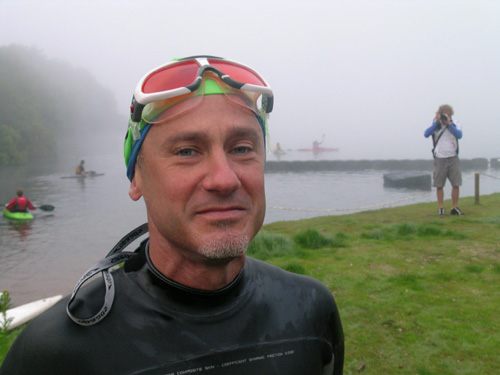
rob popper

I think that's a mixture of being tired, nervous, and just wanting to get started.

The swim takes place in Ellingham Water Ski  Lake just on the west side if the New Forest, near Ringwood.  3 laps around the lake for a total of 3800m was the plan.  However, the start was delayed by 25 minutes due to very thick mist settling in on the lake and visibility being very poor (literally, not being able to see more than 20 feet in front of you).  The organizers decided to change the swim course to make it 4 smaller laps, bring the buoys closer together so it would be easier to see them through the mist.  They probably shortened the course, in the process, although they said they would make it as close to the full 3800m as possible.

By 5:50 am, we are all slipping into the unbelievably warm and crystal clear waters of the lake. I have never seen lake water so clear and clean. And the temperature of the water made it so relaxing, it was the exact opposite of most early-morning, bracingly cold open water starts I have experienced. It really put me in a good mood and totally relaxed me right from the start.

Swim
Basically, aim for that first buoy over there, the one you can barely see, and then aim for the next one and the next one (which you’ll barely be able to see), then turn right and aim for the next one and then turn right again, then 2 more, then turn right and that’s one lap. Then repeat it 3 more times, and swim straight out to the exit ramp, which you probably won’t be able to see until you are right on top of it, but there should be some kayakers to guide you in.  Huh? What? Which? Where? Oh, whatever.
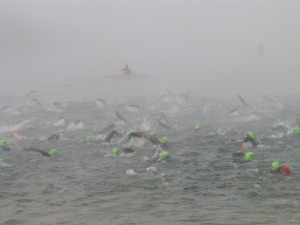
When you can’t see the marker buoys to make sure you’re on the right course, just follow any other swimmers you can see in front of you and hope they’re heading in the right direction.

Very disorienting, very surreal. It was sometimes easier to see where you were going by looking under the water (see the cables that tie up the buoys from underneath) than by looking above the water.

I settled into a very smooth, very steady style of swimming early on and really enjoyed the whole experience thoroughly. At the end of the first lap, I found someone who seemed to be swimming very straight and at a pace slightly faster than mine, so I got on his toes (drafting off of a swimmer in front of you is sort of like drafting on a bike, in that you can get pulled along in their slipstream and go at their pace with less effort) and stayed there for 2 laps.  Lovely!

I came out of the water bang on the 1 hour mark, which must mean that the swim was shortened significantly. 1 hour 15 minutes was my target time, and I am pretty sure I didn’t swim that much faster on the day.

T1
Sandy transition area, taking my time trying to dry off my feet, get some socks on, cram some spare tubular tires into the back of my trisuit. Oh, yeah, don’t forget the Endurolyte salt and mineral tablets Kev recommended! And sun cream, put on lots of sun cream. Okay, enough faffing, off I go!

Bike

Didn’t get a chance to check out the course the day before. Usually a big mistake not to check out the course. Usually means that I will go around the first lap, feeling my way around, unsure of how to pace myself, trying to hold something back for the other 2 laps of the course to follow, but still somehow get the pacing wrong. Yes, that’s pretty much what happened.
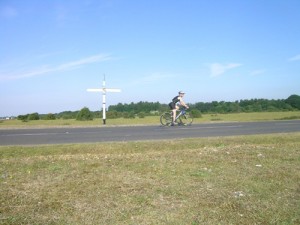
I found the two biggest challenges of the bike ride to be boredom and discomfort.  A small race like this means that you will rarely see other cyclists as you cover 112 miles of road, going round and round and round the New Forest. Not like going for a long ride with Kev, Roz, Lance, Avi, Guido, Naomi or Becky and having someone to chat with. I also learned that my tri-suit didn’t really have enough seat padding to keep my butt from getting sore on the ride, and I probably should have worn some proper cycling shorts.

I had hoped to complete the bike course in under 6 hours, but wasn’t too upset with about 6:20 on the bike. Note to self: always check out the course before the race and wear proper cycling shorts next time. Also, find ways to cope with boredom, or else do shorter races next year.

T2
Cycle into Sandy Balls Holiday Village (I kid you not), dismount, run with the bike into a new racking area, and then run into the changing tent where I pick  up my run kit (they give everyone a separate bag that is marked and waiting for you, since the transitions take place in two different places). Sit down in a chair and get fanned by some volunteers. Very nice, chatty, relaxed, friendly. Volunteer reminds me to put lots of sun cream on my shoulders and I missed a spot on the back of my neck. Pull on the compression socks and joke with the others that we have 8 hours to get around the course before we have to be worried about the cut-off time, so it should be an easy run today! Hah! Yeah, right!

Run
I could go on and on about the run, but I won’t. I’ve probably gone on and on in this report enough already. The run was brutal. It was mostly a trail run along sandy, dusty, gravely, hilly, exposed terrain. The weather was hot, there was not a cloud in the sky, and at least half the trail had  no tree cover.  It took me a little over 5 hours to run this marathon. I can usually run a marathon in 3.5 hours, and I have done a fair amount of trail running and races this past year, so I did not think it would be this tough.

In some races, there is a point where you see your targeted, ideal finishing time disappear from sight. You try to bargain with the targeted time, like, “If I can just dig a little deeper and pick up the pace again, get some inspiration from somewhere, then maybe I could make it.”  Then, you re-set your sights on some new targets, like, “Okay, 12 hours is out of the question, but you can still stay under the 13-hour mark.”  Then, sometimes, you reach another point, a slightly more dangerous point (from the view of racing performance), but a much more liberating point, where you say, “You know what? Just get me across the finish line in one piece. Don’t let my daughter see me crawling, crying, or stumbling into the medical tent to be hooked to an IV.”

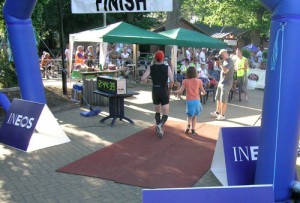
And, so I finished the trail run on just over 5 hours, and ran slowly but steadily to the finish line. My daughter jumped over the barrier at the end, took my hand and ran with me across the finish line. THAT was the highlight of my day!
Epilogue

It is the next day and I often judge my race-day performance, on how quickly I can recover. I have a family, work commitments, travel plans and a life to get on with. Triathlon training and racing is important to me, but the other things in my life, ultimately, are more important.  When my daughter says to me, “Dad, am I going to be late to school because you’re hobbling around, walking like an arthritic turtle, after your latest marathon/ultra-marathon/triathlon?” it reminds me that I have a responsibility to the people I love, and life goes on when the race is over.

Today, I feel surprisingly good. My legs were really killing me yesterday and I thought I might be hobbling around for a week or so. But (largely thanks to my CW-X compression tights) today, I am feeling pretty good and walking almost normally. And, Ella got to school on time this morning! Much more important to me than finishing under 12 hours.
Reading Time: 5 minutes

Swimming

The sound of zipping up your wetsuit early in the morning.

The small ripples you make in the water when you get in. The splashes other people make when they get in.

They squeal and make high-pitched noises, but you have done this so many times before in much colder conditions, you just sink into it quietly and don’t make much noise. Warm up slowly, get the blood moving gradually.

The even steady rhythm of hands entering the water, good catch at the front, full stroke all the way through, relaxed hand and high elbow recovers to the front.

There is a tiny drip-drop sound that droplets of water make as they drip off your hand when it recovers back to the front and then you smoothly, purposefully place your hand back in the water.

Your legs don’t make much noise when you kick steadily and smoothly. It’s more like a percussive beat in the background.

The sound of your breathing, quick strong inhale, slow steady exhale.

Your ears might be covered by your swim cap(s) and you are cut off from the rest of the world.

Consistent breathing every 3 strokes, sometimes every 4 or 5 or 6 or 7 strokes.  At the very beginning and at the very end, maybe every 2 strokes.

Your heart beating in your ears. The hands, legs, breathing, heart all fall into synch with each other.

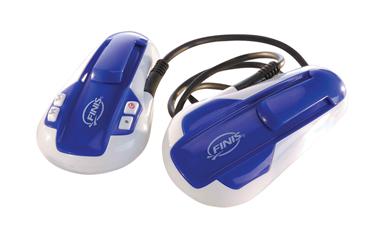
How is it that people get bored when they are swimming? How is it that they say they don’t have enough to occupy their minds and ears?  As cool a gadget as it seems, I can’t imagine wanting to get the Finis SwiMP3 player, myself.  There is more than enough for me to listen to. Maybe when I start swimming more than 5k I’ll think differently…

Cycling
Cycling shoes clicking into pedals. When you can do it without looking down, when you know the feel of the shoes and the pedals and you’ve done it 100 times before and all you need to do is listen for the right sort of click sound. (There is a wrong sort of click sound that sounds like the right sort of click, but isn’t exactly the same.)

The sound of fully inflated tires against smooth pavement. Whizzzzzzz along early in the morning, going off to meet some friends for a long ride, or maybe just head off on your own.

The clean, well-oiled chain as it zips around the rear cassette up towards the front chainring and back around through the rear derailleur.  Smooth and nearly silent. When the morning is quiet enough and the streets are empty enough, you can hear it.

The clacking-buzzing sound of the freewheel, when you stop pedaling and the back wheel keeps spinning and it makes that sound of freewheeling.

The steadier, slower rhythm of pedaling uphill. Move the bike, not the body, keep driving down and all the way around on the pedals. Steady, maybe slightly uneven rhythms. But it’s your rhythm, and when you feel good, you own that rhythm.

Up out of the seat and harder on the pedals, picking up the pace on the hills and pushing a little faster.

The sound of your breathing getting heavier on the hills. Most of the time you don’t notice the sound of your breathing, not like you do when swimming or running. But, on the hills you notice.

You don’t need to look at your heart rate monitor to know how hard you’re pushing, how much longer you can hold it like that. When you’ve done it 100 times before, you just know. And sometimes you push harder, sometimes you hold something back for later. It’s your rhythm, your choice.

When you go really fast downhill and stop pedaling, you probably can’t hear it any more. The wind is rushing through your ears, your helmet, your clothing so fast that all you hear is fast-moving air.

You take a drink on the downhill and re-fuel for whatever comes next. The sound of a bottle that is almost empty, liquid sloshing around audibly. Needs to be switched with another bottle you brought or one you’ll get at an aid station.

Brakes touching the rims. Slowing down slowly, steadily or abruptly.  Metal rims sound different than carbon rims.

You can hear when your brake pads are getting too worn out, feel when the cables need a little tightening.

You can hear when your wheels aren’t true and the spokes need tightening.

You can hear when the brakes aren’t in perfect alignment.

You can hear when the derailleur needs a little adjustment.

You can hear when cars are approaching from behind.

You can hear around corners, sometimes, approaching cars from the sides or up ahead.

Not always, but sometimes you can hear another cyclist come up behind you.

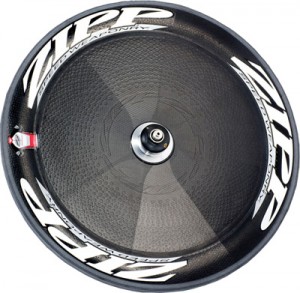
Those guys with the disk wheel on the back, you can hear them coming a mile away. It’s like a noise Darth Vader would make if he were riding a bike, like some hellish, basso profundo, voof-voof-voof sound that is coming to get you and you are helpless to escape.

Who on earth would want to listen to music on a bicycle?  There is so much to listen to, to listen out for.

Well, maybe on the turbo trainer. Yes, I will admit to making playlists and listening to music when stationary. But, never when I’m out on the road.

Running
Pulling on compression socks, for a longer run, strapping on a heart rate monitor or a GPS to tell you how far, how fast, how hard. Small sounds, maybe the occasional electronic beep to tell you something is activated or there’s an error message.

I can understand people wanting to listen to music while running. Most people seem to run because they feel they HAVE to run – maybe it’s the cheapest, easiest way they can think of to lose weight or stay in shape. But, if you LOVE running, then it’s different. There’s plenty to listen to without music in your ears.

The sound of your feet hitting the ground. You can tell a lot from the sound your feet make, if you listen out for it. Pronation, supination, heel strike, fore-foot strike, strong ankles, wobbly ankles, short stride, long stride.

The surface you run on makes a big difference, too. The relative flat sound of running on streets, up and down sidewalks. The gravelly sound of running on paths. The crinkling, crunching sound of leaves and twigs and grass on a trail.

Your breathing is much more pronounced when running. Your heart rate will probably be more elevated than in the other two sections.

You can hear it more in your ears, feel it more in your whole body, your breathing, your heart pounding.  It’s more like it was on the swim, but now the sounds from all around you are part of it, too.

Early in the morning, you can tell the changing of the seasons, predict the weather for the rest of the day by listening to the birds around you, even in the densest most crowded cities.

Need to listen out for cars, too. Hybrid cars have the unfortunate distinction of being the toughest to hear coming, so you need to be specially careful about them.

There’s always music playing in my head. Not full songs, but usually my favorite bits that I keep playing over and over again.

The bass intro to “Superstition” by Stevie Wonder, up until “Very superstitious writing’s on the wall.”

The intro to “Back To Life” by Soul II Soul, up to “Back to life, back to reality.”

The chorus of “Sex on Fire” by Kings of Leon, as well as the line “Hot as a fever, rattling bones.”

Who knows what will play in my head next time. Something I heard on the radio this morning, something I heard 25 years ago at Danceteria (“A E A E I O U U, and sometimes Y-ii”? oh, no!), something my daughter played over and over again last week (“promise I made, promise I made, started to fade, started to fade”? hmm, okay…). I know I can’t sing worth a damn. But it always sounds great in my head.

Reading Time: 3 minutes

As a triathlete, you kind of have to get used to early mornings. Most races will start pretty early, and you’ll probably find you have to get up at ridiculously early times to get to the races on time (but, like, how do you get a decent night’s sleep when you have to get up at 2am for a race?). It’s also generally a good idea to try and fit in your longer training sessions early in the day, so you get it out of the way and still have time for the other people/things in your life.
On top of that, as a triathlon coach, I am still getting used to the fact that people mostly want to be coached either very early in the morning or later in the evening.   Getting up at 4-4:30am 3 days a week so I can do my job still takes a lot out of me, especially when you add 20 minutes up to 1.5 hours travel time each way to coach these sessions.  But, it’s still my favorite time of the day.

I know it’s not just a triathlon thing, I know lots of people like to get up early to catch the good waves, the fresh powder, the greens that have not been trampled.  But, here are some of my observations and meditations:

  • I LOVE riding around the streets of a big sprawling city like London or Chicago or Beijing when they are empty and you feel like you own the place or you are the star of post-apocalyptic movie (without the zombies or robots)
  • Foxes live in a lot of the parks in London, and the only time you will see them is in the very early hours of the morning , and they are surprisingly shy and tame-looking

  • The sight of rabbits darting into the hedges, scurrying across a field, or just plain running away as you approach is probably THE most enchanting sight I have ever seen
  • Geese and swans, however, can be vicious bastards if disturbed in the middle of their early morning rituals
  • There are still a surprising number of electric milk floats working all over London
  • People who get up and go to work in the early hours of the morning tend to be the most chilled out and approachable people, everywhere I have ever been (US, Europe and Asia)
  • Getting up early in the winter time, on a dark and cold morning, is especially awesome, because even fewer people do it, and you feel like you belong to a very elite club

  • If you are not a fan of sun-rises, it’s probably because you haven’t experienced enough of them, so force yourself to get up and out that early some time and you might just surprise yourself with how much you enjoy it
  • I like to be reminded that once I was the sort of person who stayed up until 5:30am and then came home from fantastic nights out, and now I am seeing it from a different side

I guess that’s the part I like the best about 5:30am: the chance to see things from a very different perspective, maybe surprise yourself, maybe experience something really unique. While you avoid the broken glass and drunk drivers.

Please feel free to add your comments and meditations below.

Reading Time: 3 minutes

Okay, confession time!  I don’t know much about fetishes, but I think I have developed a wetsuit fetish.

One of the things I love about doing triathlons is wearing wetsuits. I love open-water swimming, anyway, with or without a wetsuit. I am a Pisces and maybe that has something to do with it. But, with a wetsuit, you get more buoyancy (so you have to do less work to stay afloat), get more streamlined (so you fight the water less) and basically I swim at least 10% faster when I wear a wetsuit.

But, it’s more than that.  Without trying to change the tone of this wonderful, gadget-obsessed, slightly geeky blog, I am going to go out on a limb and say that I think wetsuits are sexy. Not sexy in any kind of immediately obvious way (you know, all wrapped up in black neoprene and stuff), but sexy in the sense of making you feel more powerful, more capable, more like…well, a superhero or something.
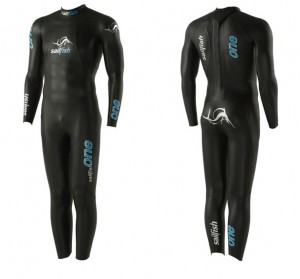
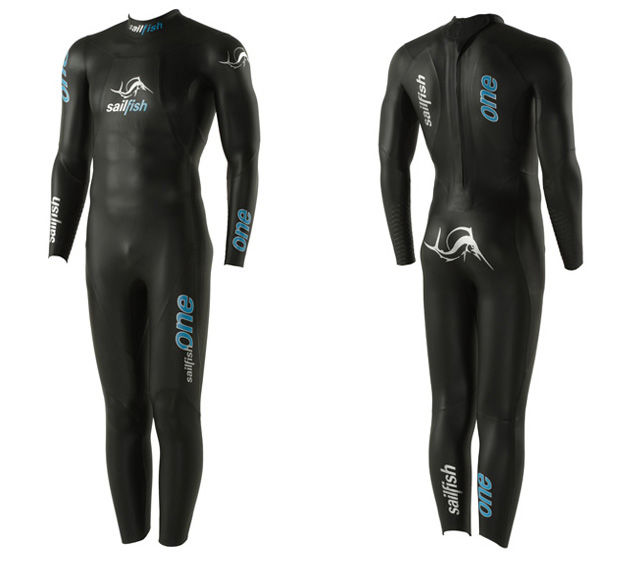
Tell me you don’t think you would swim faster, look cooler and generally feel more sexy in that Sailfish One over there. Am I right or am I right?  Maybe I’m totally crazy and it’s time for me to get a new hobby. But, if I’m crazy, then why did they put that Sailfish graphic on the butt?  Just answer met that.

As a coach with Swim for Tri, I am lucky enough to have been given some awesome deals on some awesome wetsuits. And, this year we are sponsored by Speedo, so we have been given a pretty nice range of Speedo wetsuits to try out. I have tried (and loved) the Speedo STR Pro, which is probably the best-fitting wetsuit I have ever worn.  I am looking forward to wearing it in my races this summer, and I am counting on it (and it alone, without needing to do any more serious swim training) to make me swim faster than I have ever swum before.

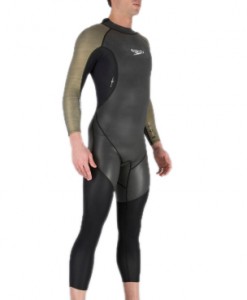
And then, the other day, I had a revelation. I tried the Speedo Thinswim wetsuit when I was coaching at a swimming pool early one morning. I had encouraged everyone to bring their wetsuits to the pool so that we could talk about putting them on, taking them off, and how they change your front crawl technique. I brought the Thinswim because I didn’t want to be wearing a wetsuit of normal thickness (Thinswim is about 1mm thick whereas most wetsuits are about 3-5mm thick) all morning and get dehydrated while I was coaching.  But, here’s the revelation: once I got the Thinswim wetsuit on, I did not want to take it off.
Forget about the fact that it is not nearly as buoyant as the other, thicker wetsuits, and it probably won’t make you go as fast as a normal, thick wetsuit. Forget about the fact that it is harder to get the Thinswim on because the material is so much thinner and harder to pull on (especially in the arms). Forget about the fact that the thinner material leaves NOTHING to the imagination, and everyone will know what religion you practice.  I wore it for 4 hours the other day and honestly wanted to keep wearing it all day long.

It makes me want to swim around the world, if only to have an excuse to keep wearing the Thinswim for months at a time.  So, that’s gotta be a good thing, right?

Even as I type this, I am debating the pro’s and con’s of stuffing it in my backpack as I set off for the Alresford Music Festival, just on the outside chance that I get a chance to wear it at some point this weekend  – a weekend which, I might add, my daughter has banned me from all triathlon-related activities.

So, just to finish off the sordid picture I have drawn for you, I have been reduced to sneaking around behind people’s backs so that I can get a few minutes of sheer multi-sensory delight with the Thinswim.   Maybe it will rain really heavily and it will make perfect sense for me to walk around in a wetsuit.  Maybe there are worse things to be obsessed with.

Reading Time: 3 minutes

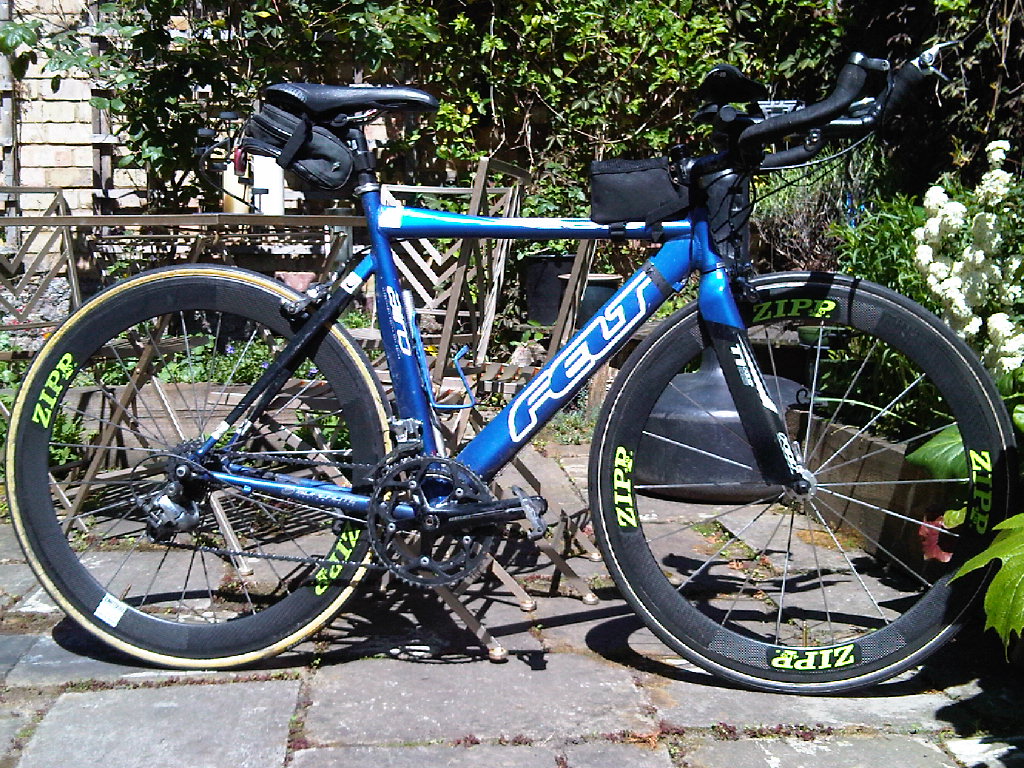
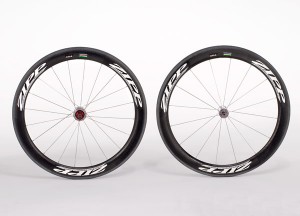
In a moment of weakness, I put in a bid on eBay for a set of Zipp 440 carbon fiber tubular tires a few months ago. A new set of those wheels, the Zipp 404 tubulars, cost at least $1,500 for the pair (and that’s without skewers, cassette, tape and tires), and there was a pair for sale at about $500, with tires and cassette.

zipp 440

As I got caught up in the heat of eBay bidding, I also undertook a crash course in tubular carbon fiber wheels to see what I was getting myself into. Here are the pluses I learned about:

  • obviously, carbon fiber wheels are lighter and stiffer than aluminum or alloy wheels, so they’re faster
  • tubular tires are glued to the rim, rather than held on by the metal “hooks” of clincher tires, so tubular wheels are lighter than clincher wheels
  • tubular tires are much higher pressure (150-200 psi versus 80-120 psi) and so can be much faster, thinner tires than clinchers
  • Zipp carbon fiber wheels like these make pretty much any bike look totally awesome

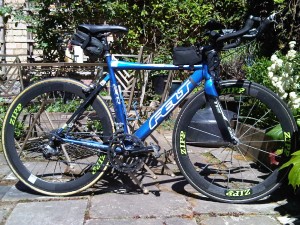
My baby, with aforementioned Zipp 44o's

Well, needless to say, I won the bidding war and became proud owner of a set of Zipp 440’s and then quickly learned some of the minuses of owning these wheels:

  • you need special, compressed-cork brake pads for carbon fiber wheels (unless they have an aluminim strip around the outside) because your regular rubber brake pads will damage the carbon fiber rims, so that’s an extra cost there of about $20
  • you may not be able to fit your normal accessories on your new wheels (speedometer sensors, etc) since the spokes and wheel shape will probably be very different on these wheels, so that’s a pain
  • flat tires with tubulars are VERY expensive and a major pain in the ass – you can’t just whip off the tire, stick in a new inner tube, pump it back up and then head off like you can with clinchers; you have to peel the tire off the rim, re-glue a new one on and work it back on by hand (DO NOT ever try to use tire levers on a carbon wheel, unless you want to destroy them)
  • you can’t use a hand-held portable pump to get enough air into tubular tires when you re-inflate them (maybe only for very short emergency purposes, but 80-90 psi from a hand-held pump just won’t cut it on 150-200 psi tires), so you end up carrying around lots of expensive little CO2 cartridges to inflate tires on the go
  • you can buy repair kits for tubular tires, if you want to spend an entire day unstitching the sewing, repairing and replacing the inner tube and then re-stitching the tires back together again – OR you can throw away the flat tire and replace it with a new one – new tubular tires cost about $40 to $120 … EACH
  • yup, that’s right! every time you get a flat you are talking about a minimum of $40 for a new tire, maybe $5 worth of rim tape and another $5 for a CO2 cartridge – compare that to fixing a flat on your clinchers with a new $7 inner tube

On my first 4 rides on these new wheels, I got 4 flat tires. The costs mounted up quickly and I started to panic. It was costing me about $60-70 every time I went out for a ride, and it was seriously taking the fun out of these sleek, fast, sexy new wheels.  I began to look at my old aluminum clincher wheels and think that maybe I had made a horrible mistake and needed to go back.

But, I didn’t. I stuck it out. I did several more long rides on the 440’s and didn’t get any more flats. I ride around now, with 2 spare tubular tires in my back pocket, a roll of tub tape, and about 4 CO2 cartridges, ready to deal with flat tires if and when they come along.  But, touch wood, it hasn’t happened for the past 5 rides.

And these wheels are awesome. I am noticeably faster on all gradients, sharper around the corners, and I am having significantly more fun than I was at this time last year.

So, my verdict: I love these wheels. I am going to keep them. I am having sooooo much fun with these wheels.  They are more expensive to own and maintain, they are more hassle to fix, they require more time and attention than my old wheels. But they are soooooo worth it.

Posted by: Robert

Reading Time: 5 minutes

Sorry for the long silence. Been away for a while, getting stuck into my big challenge this year: training for my first ironman triathlon (the Forestman).

For those of you who didn’t know (and if you already knew this, then please allow me to try and impress you once more with the sheer numbers), an ironman triathlon involves 3.8 km (2.4 mi) of swimming, 180 km (112 mi) of cycling, and 42.2 km (26.2 mi) of running, all in one continuous event, with the clock running the whole time.  A guy like me (45 years old, been doing triathlon for about 8 years now, training pretty regularly, but not winning any medals in any races) will do about 75-85 minutes of swimming, about 6-6.5 hours of cycling and 4-4.5 hours or running at the end of it all.  The top guys will routinely finish in under 10 hours, bless ’em. But, I’ll probably be looking at something closer to 13 hours (gotta include time in transition between events, since the clock is always running, and it makes sense to take 10-15 min to dry off and put some clean socks on before you set off for a 6-hour cycle ride, rather than rush through it and be uncomfortable or getting blisters for the next 6 hours). Most courses will have about a 17-hour cut-off point after which they have to clear the course of anyone who hasn’t finished by sun-down.

Tapering
My race is about 2 weeks away now, so I am officially in the “taper” phase of training, which means I am doing fewer and fewer hours of training each week (at my peak, I was doing about 15-20 hours each week, now I am down to about 10-12 hours a week), so that I get to race day feeling fresh and well-rested. But, at the same time, I am trying to keep the intensity of each session quite high, so that I keep my fitness levels and sharpness high for the day of the race. But, it has also given me more time to step back and reflect on what I have been doing this year, think about the training I have done so far, and what factors have contributed to getting me this far.

Milestones and motivation
Some ups, some downs, and some key milestones along the way. It helps to have some carefully targeted events to measure your progress and keep you motivated along the way, such as:

  • Back in early April, I did a 5k Swimathon for charity, which was an excellent exercise in settling into a good steady pace for 102 minutes of non-stop swimming. And it gave me a lot of confidence to know that I could swim way more than the 3.8k I’d need to swim in an Ironman. Of course, at the Swimathon, I swam next to Dan Bullock, one of Britain’s fastest veteran swimmers, which was simultaneously humbling and inspiring. He finished in about 62 minutes, or 40% faster than I did.
  • A few weeks later, I got offered a last-minute spot in the London Marathon, and I managed to get around in 3 hours and 28 minutes, which I was very pleased with.
  • Lots and lots of long cycle rides with fellow triathlon club members, including one super-gorgeous, super-tough day of about 130 miles trying to keep up with some incredibly fast, ridiculously tall guys 10 and 20 years younger than me.  Again, humbling and inspiring seems to be the theme to my training this year.
  • Joined a relay team to swim across the English Channel to raise money for charity, later on in September. That has given me something to look forward to once the Forestman is over (and lots of people tell me about the post-ironman blues, that anticlimactic feeling that sets in after achieving such a big goal as this).

And, I’ve learned a few valuable lessons along the way, about myself and about some of the people in the triathlon community around me…

  • Given half a chance, your typical triathlete who trains for ironman-distance races, will become obsessed.  I mean, if you are an amateur athlete then trying to find 15-20 hours a week in which to do all your training, you kind of have to be obsessed. It helps that I am a triathlon coach and so some of my training gets done in the course of working. But, family, friends, holidays, working schedules, sleeping routines, meal times, and your favorite TV shows will all end up taking a back seat to this all-consuming passion.  There’s no way to sugar-coat it: I have seen my fair share of marital strife, disappointed friends, and unhappy kids this year and some parts of my life are in worse shape than they were before I started this.  Has it been worth it? Ask me in a few weeks.
  • We also can be very boring companions, we iron-distance triathletes.  There are times that the only people who want to be around me are other triathletes, especially those who are also doing iron-distance training. I typically run out of small talk within 15-20 minutes and eventually resort to ironman-related conversation, pretty much wherever I go, whatever I do.  I have been known to recommend to 20-something fashion models that they eat sports gels and drink sports drinks, instead of resorting to their natural diet of coffee and cigarettes, in order to get through their rigorous schedules.  So “bored incomprehension” is the look I am getting used to seeing a lot more these days.
  • And, when we’re not training, we’re recovering from training, or we’re eating everything in sight, or we’re going to bed early to get ready for the next training session.  So, in the other hours of the day that we’re not training, it still is all about the training.
  • Once you give in to the obsession, get used to the unsociable hours, and accept the fact that all of your friends and family have given up on you, it really isn’t so bad. If you’re lucky enough to find some other people to train with, then you can all motivate each other and commiserate with each other. But, the actual training itself is really not that tough. You will go slower than you would normally go for shorter distance training, and you just have to stick it out for a lot longer. Boredom is probably the toughest part of an 8-hour training ride or a 4-hour training run.
  • You can probably eat anything you want while you are training for iron-distance races, and you will still probably lose weight. Not that you should subsist entirely on ice cream and coke, but you probably will have to consume a huge number of calories to get your body back in balance when you get back from an 8-hour training ride. If you choose to consume 2000 kcal of salad and whole grains, that is great! If you choose to consume 2000 kcal of  burgers, fries and ice cream, then that ain’t so bad, either.
  • It’s worth saying one more time that without the support and camaraderie of my friends at Tri London, I would not have made it through that tough, freezing winter with so many useful hours of training under my belt.  Whatever I do at the race on June 27 will be almost entirely due to the support of people like Kev, Roz, Lance, Guido, Andrew and Stephen, dragging me around Southern England at 6am almost every Saturday, and waiting for me at the end of every hilly climb.

Still feels like a long way to go, and maybe longer still once I sign up to do it all over again next year.

Posted by: Robert

Reading Time: 3 minutes

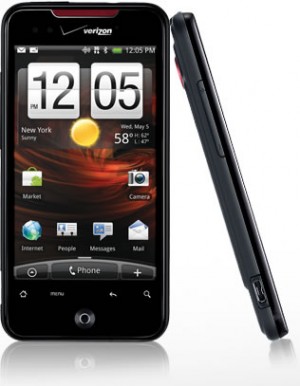
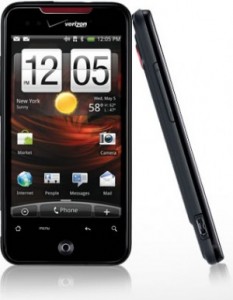
Android continues to mature in the smartphone market and the HTC Incredible on the Verizon network gives the Apple iPhone a whole host of reasons to take notice. First and foremost the HTC Incredible gets a signal, an increasingly difficult task at least for myself and fellow iPhone/AT&T users in our neck of the woods (from time-to-time my “neck of the woods” includes New York City).

A fast and fully-featured Smartphone, the HTC Incredible works extremely well for both voice and data. It’s a light, sleek phone you barely notice in your pocket, yet is packed with power and features that surpassed any preconceived notions I had going into the tests.

The iPhone continues to be the benchmark for Smartphones and happens to be the smartphone I pay dearly for month-after-month. While Apple prepares to roll-out the iPhone 4 on 24-June, 2010 with a number of new features, I may very well be a Verizon customer before then. The HTC Incredible on the Verizon network out-performed my iPhone in coverage, voice clarity and network speed (browsing) and already includes multi-tasking and folders (2 examples of what to expect in the new iPhone iOS 4). If the Incredible provided a wi-fi hotspot or tethering (something out-of-the-box and not rooting or installing anything), I would have already made the leap.

Interface
The HTC Incredible’s interface takes some getting used to. It wasn’t obvious to me how to quit an application and stop it running in the background. Not only does this tax the processor, but when I finished testing Skype (great sound quality over the 3G network in my tests by the way), I inadvertently left the app running and kept myself logged-in for the rest of the day.

HTC’s updated ‘Sense’ user interface, while polished (thanks in large part to a powerful 1GHz processor that can support it), is still not as natural as Apple’s interface in my opinion. I do like the ability to view the separate screens as cards and can quickly jump between with smooth transitions. But in terms of overall ease-of-use, or intuitiveness, the iPhone still has it.

Applications
The Android Marketplace is loaded with free and paid alternatives similar to what you can find in Apple’s App store. Apple boasts roughly four times the number of apps as android (reportedly somewhere around 50,000 apps). While many people don’t like that Apple controls what can and can’t appear in the App Store, it does add a layer quality control. Third party apps are probably the leading cause for Android crashes on what is otherwise a stable OS.

Smartphone Performance
Following are notes about the Incredible’s performance in key areas to consider for any smartphone…
Voice: High quality and with far less dropped calls and a greater service area than Im used to (on existing 3GS iPhone/AT&T)
Data: Fast web browsing. Gmail and Exchange support
Camera: 8-megapixel autofocus camera with video and LED flash
Music: Sounds OK through speaker and very good with headphones (headphones are also required to use the FM radio app)
Display: 3.7-inch AMOLED (800 x 480 pixels) is bright and very vivid
Interface: Sense; Improved over earlier Android units tested, but still not as intuitive as the iPhone
Storage: 8GB expandable to 16GB with microSD card (sold separately)
Speed: Fast processor (1-GHz SnapDragon processor)
Battery: Battery will get most users through the day, but for very active users (music, Facebook, talk, numerous Apps, etc) you will want to either bring along the cable, or balance-out your day better

Price: $199 purchased online with 2-year Verizon contract

Posted by: Lawrence