General Fitness

Reading Time: < 1 minute

I’ve owned a Suunto Observer for years, a gift from the wife and I love it. With it I can tell which direction I’m headed, altitude, barometric pressure, temperature and of course the time. While somewhat bulky, it is still stylish IMHO and once configured performs well.

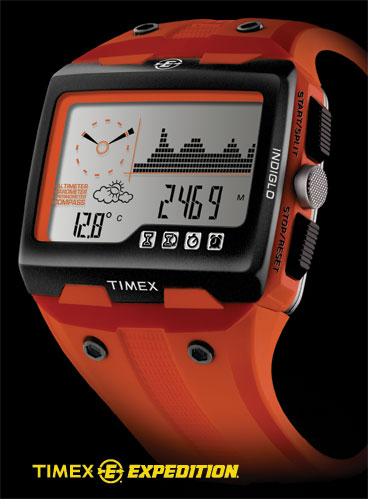
Timex will start shipping the Timex® Expedition® WS4™ on May 1, 2009. Similar in functionality to the Suunto, but no where close in looks, the gargantuan Expedition WS4 offers altitude, weather conditions, compass heading and time at a glance.

Unlike the Suunto, which has you spinning 360s to configure the compass, the Expedition WS4 can be used the moment it comes out of the box UPDATE: Both the Suunto and the Timex Expedition WS4 require manually calibrated. Timex also offers a fabric band to make wearing it over your gear easier, allowing for outside temperature readings, not your arm.

Dubbed a “wrist-top adventure instrument,” the Expedition WS4 has weather forecasts that look to be fairly simple to read. On my Suunto I need to be somewhat of a weatherman and figure it out for myself. Available in a half dozen colors, water resistant to 50 meters and lit by Indiglo, the Timex Expedition WS4 is expected to cost about $200.

Posted by: Jay

Reading Time: < 1 minute

Alaia Wooden Surfboard project: Post 1 | Post 2 | Post 3 | Post 4 | Post 5 | Post 6 | Post 6b | Post 7 | Post 8

I’ve finished oiling the Alaia and all that’s left to do now is ride the thing. I had a lot of fun building the Alaia and meeting others out there doing the same all over the world. In the end I’m very pleased with how it turned out and I’m really anxious to go and ride it.

I applied linseed oil a total of 4 times, with a full day between applications. I was pretty generous with the linseed oil, letting it soak in for 10 minutes before wiping away the excess with clean shop rags (I used these same rags to apply the next coat). I did light sanding between coats, after the second coat I noticed it was gummy in parts where I didn’t get rid of all the excess. Sanding those gummy areas didn’t help, so I went with a Scotchbrite pad I normally use tuning snowboards and it cleaned it right up.

This is the end of this series and I open it up to any questions or comments. I’ll post an update/pictures when I get it in the water (hopefully in about 4-6 weeks). There are a few of us eager to give it a go and it should make for an entertaining session!

Posted by: Lawrence

Reading Time: < 1 minute

For the past seven years, the boffins at Lunocet have been working to develop the most efficient form of underwater human propulsion. The result of those efforts can be had for $1,800 in the form of a kind of mono-fin that introduces what I discern to be 2 unique features setting it apart…

  1. The first of these features are the footplates. Wearing bicycle shoes, the user clips into aluminum footplates or stretch resistant non-rubber foot pockets.
  2. Precisely positioned hydrofoils designed to increase in power on the up-stroke as compared to conventional mono-fins.

The Lunocet comes in 4 models, the Aphotic, Overt, Naked and Widder. The difference between these models is unknown. While pleasant to look at, the Lunocet Web site doesn’t provide many details. There are no doubt some skilled industrial designers and web designers at work at Lunocet, how well the fin works is unknown.

The 2.5lbs Lunocet fin can reportedly help you swim around 8MPH. or more than 3MPH faster than Michael Phelps! With $1,800 less in your pocket maybe 8.2MPH and you’re waiting for Mike on the pool deck with a freshly packed bowl and some Doritos.

Posted by: Jay

Reading Time: 2 minutes

Alaia Wooden Surfboard project: Post 1 | Post 2 | Post 3 | Post 4 | Post 5 | Post 6 | Post 6b | Post 7 | Post 8 Finis

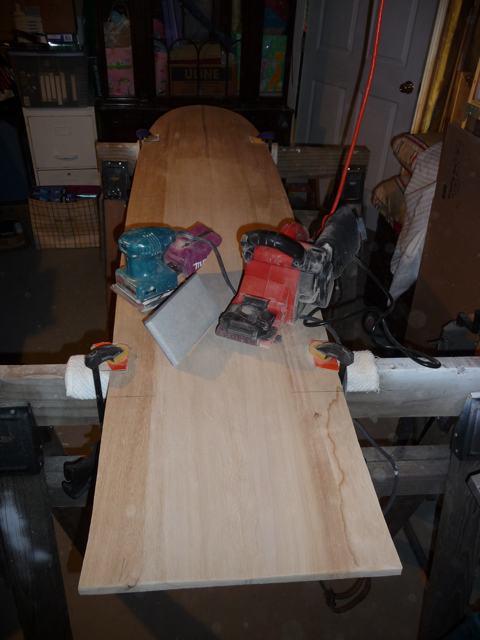
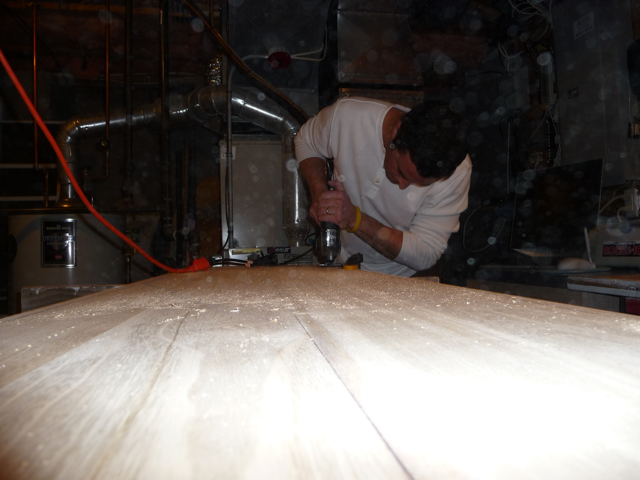
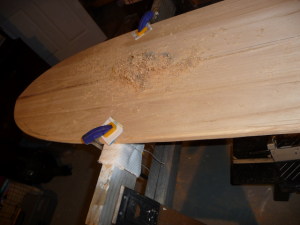
They say a picture is worth a thousand words. In this case I think the words better do the talking because it’s difficult to capture the progress made with the concave in a photo. I haphazardly arrived at a method for creating the concave and it goes like this…

  • Snap center-line (nose to tail) with chalk
  • With the belt sander on the center-line at shallow angle, I quickly and carefully sand in one direction
  • With hand sander, I work from and apply pressure to the center and work outwards
  • I sand a length of about 18″ at a time, using 12 strokes near the center, 6 a little further out and 3 near the edge

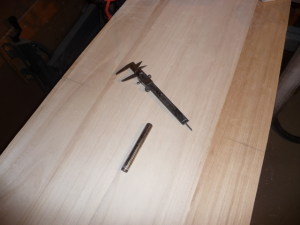
… I repeat this process over and over, each time making the concave deeper and feathering out toward the edges a little more. Reestablishing the center line helps keep the deepest point consistent. I happened to have a weighted metal rod I used to use when tuning skis. I place this rod on the top of the concave on one side let it roll up the other side of the concave and eventually settle in the center of the board (if it doesn’t I sand more). I included a picture of the rod as well a some calipers I’ll use when shaping the rails.

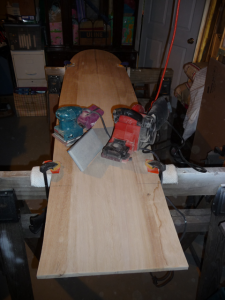
The hand sanding helps refines the work done with the belt sander. I felt a little out of control with the belt sander, but found the results more predictable when working quickly (not letting it bite too much in one place). I tried using the palm sander and it did a nice job, but the dust got out of control. It if wasn’t winter I’d be working on this project in the garage, but I’m in my workshop – which is also the boiler room , where I need to keep dust to a minimum.

The process is taking longer than anticipated, but I’m happy with the results so far. Punxsutawney Phil says 6 more weeks of winter anyway, so I’ve got nothing but time. I’ll keep working on the concave using the methods described above and start the next post on the Alaia project with the overall sanding and Linseed oiling.

Posted by: Lawrence

Reading Time: < 1 minute

Alaia Wooden Surfboard project: Post 1 | Post 2 | Post 3 | Post 4 | Post 5 | Post 6 | Post 6b | Post 7 | Post 8 Finis

Mini Post: I’ve begun sanding the concave, but it’s hard to tell in pictures so I’ll do that in the next update. I started with the belt sander and formed the shallow ‘V’ in the center of the board. The concave should start a third of the way from the nose, so at 7′ overall, I started 28″ from the nose and worked my way to the tail.

I’m not exactly practiced at the belt sander and I removed more material in some areas than others. Before I go back to the belt sander and exacerbate the unevenness, I thought it best to hand sand a bit to get it more or less back to level. I’m working with 80 grit on the belt sander and 60 grit by hand (because it’s what I had). I’ll work my way up to 220 as I get closer to the final concave. When I start applying the linseed oil in phases I’ll sand before and between applications using 280-320 grit.

Looking at the board upside down and from the back the shape loosely resembles a bat. The lowest point in the middle, rising on both sides and then slightly dropping at the ends (see the picture of Rasta’s board in Post 1). The edge needs to be sharper on the bottom since the Alaia’s hold the wave that way (no fins here). When the sanding has progressed to a point where pictures clearly show what’s happening, the explanation above should hopefully be obvious.

Posted by: Lawrence

Reading Time: 3 minutes

Alaia Wooden Surfboard project: Post 1 | Post 2 | Post 3 | Post 4 | Post 5 | Post 6 | Post 6b | Post 7 | Post 8 Finis

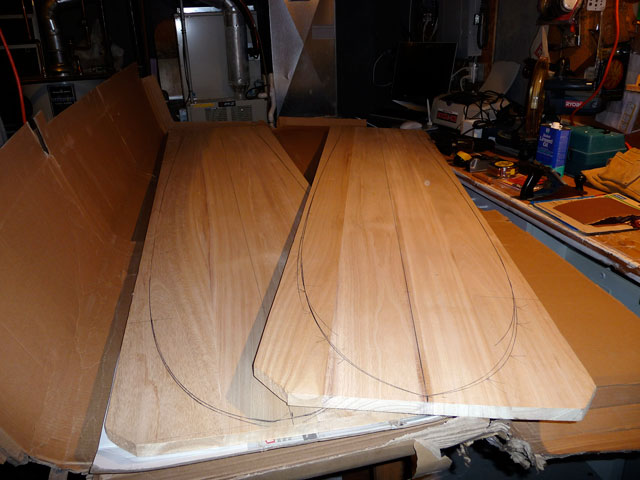
Significant progress this weekend with the Alaia project. I cut the board to shape with a jigsaw, working in one direction. I said in the previous post that I wouldn’t cut the Stuth tail, but I had a change of heart. I like the side-cut it creates and given my 24 years of snowboarding I’m drawn to that shape (yeah, I’m that old and have boarded that long!).

Because the board needed to be clamped and un-clamped (3 times) I made cuts on either side of the board, with 90° cuts to remove material as I progressed. After the jigsaw work was done I used my belt sander to fine-tune the edges to get a uniform ~3mm distance from Jon’s marks (as explained in post 2).

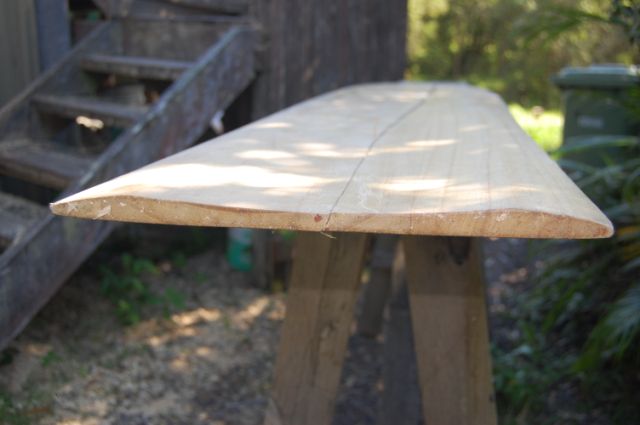
Once I was satisfied with the shape, I used a pocket plane to put a 1/4″ bevel on the top edge (you can apply very light pressure since the Paulownia wood is so soft). Holding the plane at 45° and moving in one direction, I cut until Jon’s marks were no longer visible. After inspecting and small tweaks I flipped the board and transferred the center line which I’ll use to create the concave. I also transferred 3 perpendicular markings from the top of the board at 12″, 40.5″ and 70″ from the nose. I believe these marks were used to create the shape, but it can’t hurt to have them on the bottom.

Next I’ll work on the hardest part, the concave. Jon told me the concave should start about a third of the way down the board and Tom gave me some advice on how wide.

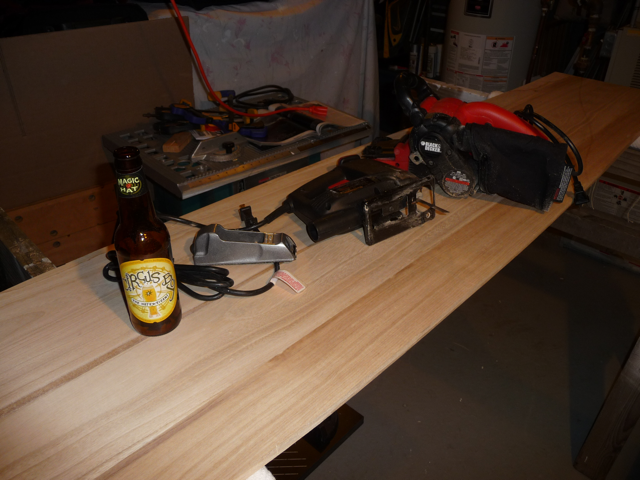
The board currently measures 7′ x 17 1/2″ x 3/4″. After the concave I’ll start sanding the entire board from coarse to fine grit, getting it as smooth as possible. After that I’ll oil (linseed) over the course of several days. I’ll apply 3-4 times and before each application I’ll do some light sanding to make it as slick as possible! toolsThese are the tools I used for this phase (a special thank you to Circus Boy, for without it, none of this would have been possible).

As always, check back for pictures and updates. Please also post your comments and advice. I’d really like to know if anyone else has worked on shaping their own wooden boards or intends to try.

Posted by: Lawrence

Reading Time: 2 minutes

Alaia Wooden Surfboard project: Post 1 | Post 2 | Post 3 | Post 4 | Post 5 | Post 6 | Post 6b | Post 7 | Post 8 Finis

It’s been hectic since I received the Alaia blank, but I plan to start on it in earnest this weekend and think I have a plan of attack (thanks in large part to Jon Wegner’s suggestions via email)…

  • Standard Finley tail in favor of the Stuth (I can always get another blank right?!)
  • All cuts are going to be about 3mm from the lines that define the board’s shape
  • Form 45° bevels on the top and bottom using a small hand plane to start to shape the rails
  • Sand the rails to shape, leaving the bottom sharper as opposed to round
  • Cut an 8″ wide channel down the middle starting 1/3 of the way down from the nose*

* I’m still not 100% sure how I’m going to shape the concave. I was thinking about holding the edge of my belt sander at an angle (30°?) and from the center of the board, moving down towards the tail going no deeper than 1/4″ at the deepest point. Then I’d repeat the same process holding the planer on the opposite side from center. This should form the deepest part of the concave – a V shape of sorts about 4-5″ wide that I can then blend out toward the rails. When finished the concave will be about 8″ wide.

I made some test cuts on the parts of the blank that are waste. With no more than 18″ exposed past the clamps the jigsaw makes a clean cut, but anything more and it chatters and ripping is evident. I’ll have to keep clamping and un-clamping as I make my way down the board.

Check back for pictures and an update on my next post. Also feel free to comment on the plan above and lend any insight.

Posted by: Lawrence

Reading Time: 3 minutes

Alaia Wooden Surfboard project: Post 1 | Post 2 | Post 3 | Post 4 | Post 5 | Post 6 | Post 6b | Post 7 | Post 8 Finis

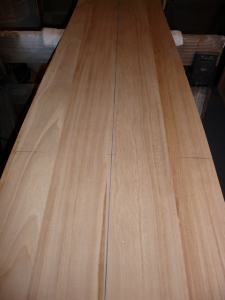
In an attempt to experience a spiritual awakening like an ancient Hawaii commoner, I decided to try and build and surf a wooden Alaia surfboard (OK, well at least build one). Traditionally a 10-12 foot fin-less board that in ancient times were made from Ula and Koa trees, my Alaia will be about 7 feet and is shaped from a blank made from light and sustainable Paulownia wood that doesn’t absorb salt water.
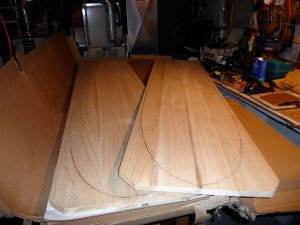
I purchased two ‘Finley’ blanks (one for a friend) from Jon Wegner at Wegener Surfboards in California. Jon and his brother Tom, Surfing Magazine’s 2009 Shaper of the Year are selling the blanks here in America, but they are made in Australia where Tom lives. Purchasing the boards from the Wegner’s was a pleasure and if this project inspires you, I highly recommend you contact Jon for your blank.

Before the blanks arrived by UPS ground, I prepared my workshop with padded saw horses, jigsaw, belt sander, palm sander, hand planes, and sandpaper in assorted grits. I’m not sure I have every tool I need or is recommended, but I’ll cautiously remove material, especially the concave, which I’ll likely do in stages after sessions (assuming I have a feel for the board). Classic case of ‘you can always take off but you can’t put back on.’

When I unpacked the Alaia’s I was pleased to see the blanks arrived in perfect shape. I’m eager to begin the project, which entails cutting the blank to shape, shaping the rails and concave and finishing the board. There are a number of resources available on the web I’ll refer to, including Olosurfer.com and woodworking forums such as woodworkforums.com.
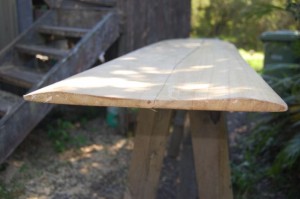
When completed, the Finley should have, according to Wegener Surfboard’s model description, “a light roll on the deck and a concave running from the nose all the way to the tail. The concave is 3/8” deep.” (Note: Jon recommended I keep more material on the board and stay within 1/4″) “This really helps keep the board from sliding sideways too much and gives the board more traction in the face.

The goal of the board is to give it just the right amount of flex. With good flex, catching the wave is easier and the board more responsive to turning.” Tom was kind enough to share the photo on the above-left of Dave ‘Rasta’ Rastovich’s board. This board has far more concave than I’ll need, but it gives an exaggerated idea of the curves.

Over the next several weeks, time permitting, I’ll be working on the Alaia and posting my experience and sharing photos on Bitness. If anyone has built an Alaia or is an experienced woodworker and can offer sage advice, I welcome your comments here, both for my benefit and anyone else interested in the Alaia.

Posted by: Lawrence

Reading Time: 2 minutes

For the past week or so I’ve been hosting back-to-back canine cabin crashers. First I watched my parent’s Wheaten Terrier and now I have my sister-in-law’s black lab (side note – the gassiest dog in the universe). Being a dog lover and not having a dog since my yellow lab Magic passed on St. Pats a few years back, I missed the walks. Even with the extremely cold weather (and now heavy snows), it’s great to have a companion to go outside with, hike and get some exercise.

After a dark walk in the woods this evening I started thinking some people may not fancy what I find as a fun and relaxing thing. I don’t mind the weather and I would always rather be outside than in when it comes to exercise. My dislike for treadmills has been well documented, but I know some demented people are twisted or lazy enough to think this a good idea for dogs as well (especially in 1° F temps which feels like -20° F).

Feets don't fail me now
My hunt lead me to one very disturbing company in Japan. Just what exactly happens when this dog loses it’s footing or simply can’t go on? I imagine Mr. Yakumora coming home to a little rump roast attached to a leash and thinking the small treadmill a curious place for his wife to leave supper.

Then there is the Pawwws Pet Treadmill who, on their product information page, answer a series of questions with some disturbing logic, such as…

Q: Is this product difficult to use?
A. Absolutely not! In fact, many of our customers say it actually saves them time by not having to take their pet out of doors, braving inclement weather, and allowing them to focus on more of their day-to-day activities.

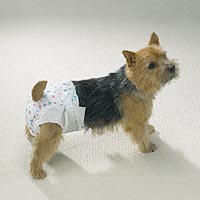
Why would someone have a dog if they didn’t have time for it? Dogs need time to be outside, smell stuff, pee on stuff, roll around on stuff – it’s called being a dog. Can’t people put on a coat and put their “day-to-day activities” on hold for 30 minutes? Who wants to diaper a dog and shut themselves in for only the most agreeable conditions?
Price: Your dignity, your dogs dignity, self respect and dirty diapers.

Posted by: Lawrence

Reading Time: < 1 minute

Apprently FreeLine Skates have been around for years, but I just discovered this new way to hospitalize myself. A kind of intersection of skateboarding, rollerblading and RipStick, the $149 FreeLine skates look like they have plenty to offer in the way of building balance, performing flat-land tricks and of course transportation.

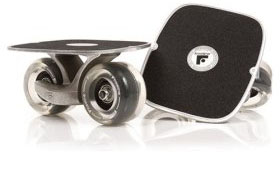
Comprised of 2 independent aluminum skates, FreeLine skates are stood on, not strapped on, using traditional skateboard grip tape to help hold you to a set of ~6 square inch plates. Two 72M custom grade polyurethane wheels are in vertical alignment under each plate and acceleration is obtained using the same motion you would on a RipStick.

https://youtube.com/watch?v=eo7rr3AKyC4%26hl

Posted by: Frank

Reading Time: 2 minutes

With temperatures well below freezing and finding myself miles away from any mountains, I’ve decided to post another indoor, off-season workout entry. For Surfing there isn’t an off-season unless, like me, you can’t afford a winter suit and find yourself bound to the shore watching the cool kids get all the waves to themselves.

To pass the time and stay in shape there are plenty of exercises that focus on strength, power, balance and endurance that don’t require any equipment, but as geeks we naturally want gadgets. Sometimes brilliant, sometimes a total waste of money, gadgets are the only thing that can get me stoked for weekend nights in my basement erasing the stress of the day.

http://multimedia.thestar.com/images/assets/179149_3.JPG

Source: http://multimedia.thestar.com/images/assets/179149_3.JPG

In the past, I’ve written about balance boards and a skateboard deck with Softrucks that helps build balance and let’s you practice tricks. Both solid low-tech gadgets I enjoy all year round – they never get old.

Two more balance trainers have surfaced and I’d like to get my hands on both to test. World-class surfers Dave Kalama and Laird Hamilton seemed to feel the SurfBall is where it’s at. Essentially a basketball under a shortboard (how is there a patent pending on this ‘technology’?), the SurfBall “…allows all users from the novice to the professional to work on developing fine motor skills and a keen sense of balance…” The SurfBall comes in three models; SurfBall Surfboard $399, SurfBall Stub $299 and the SurfBall Skate $159. The decks for the later two models resemble a wakeboard and skateboard (respectively).

The NoHo is another kind of balance trainer that uses a series of curve shaped pods which are easily attached to the bottom your surfboard. There is a well choreographed video on the NoHo Web site worth checking out. Longboard phenom Joe Aaron performs the same mind-blowing, practiced maneuvers on land that he does on the waves. I’m fairly certain Joe’s remarkable skills, which as a teenager leads me to believe he was born to surf. But you can’t totally discount the NoHo, it looks simple enough to set-up and using the same stick I surf appeals to me. The NoHo sells for $159 for boards up to 11 feet and $99 for boards up to 7 feet.

Check out both Web sites if you’re considering a balance trainer and let me know what you think.

Posted by: Lawrence

Reading Time: 2 minutes

For years Chuck Norris and Christie Brinkley have been selling a machine called the Total Gym, a machine that uses gravity and your body weight to deliver over 80 exercises. It seems to be working miracles for them, so why not another gravity-based trainer?

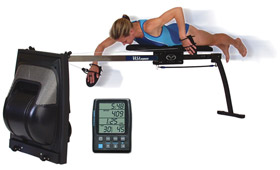
Vasa offers the Vasa Trainer, which, like the Total Gym, works by lifting your body weight up an inclined monorail and then lowering it back down. Vasa also offers a wind resistance unit called the Vasa Ergometer. Both devices are marketed towards swimmers, paddlers and surfers and have adapter kits to serve those respective users.

There are a lot of immediate and obvious benefits to a Vasa Trainer. Firstly, training anytime, anywhere is not always easy for swimmers, surfers, triathletes or paddlers who don’t live in San Diego. You need unfrozen water and I for one seem to be running out of that resource where I live in the North East. Vasa trainers also allow coaches to talk to their swimmers and see mechanics that would otherwise be hidden underwater and by churn. It’s also reported that the Vasa units require less time to train and can develop power and endurance in about half the time than in the water.

Dryland Swim Trainer

The Vasa Trainer sells for $899 and workouts are tracked manually. The $1899 Vasa Ergometer, which uses variable airflow resistance to emulate fast/slow currents, tracks your workouts and measures…

  • Watts
  • Force (both arms)
  • Stroke length
  • Distance
  • Pace

If you’re serious about swimming, paddling or staying in shape for long surfing sessions, then have a look at the Vasa web site and consider getting one of these trainers.

Posted by: Lawrence

Reading Time: 2 minutes

Tides don’t affect the breaks I surf all that much, but at my favorite spot, low slack tide (between low tide and when the incoming tide starts) is probably slightly better. That’s all the reason I needed to go out and plunk $95 on a new Quicksilver Moodak watch. Even though I carry my iPhone with me at all times and have the very capable and more informative TideGraph app.
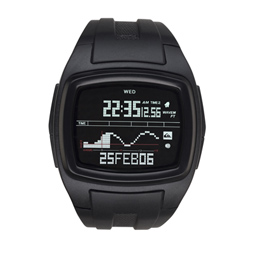
The Moondak version I have is all black – including the screen and maybe I sound like a curmudgeon, but I’ll be damned if I can read it unless I find myself in close proximity to a 1million candlepower halogen light source. Another annoyance with the watch is the number of times I go to glance at the time, only to be in tide mode. The convenience of quickly checking the time is a frustrating 5 mode clicks away.

The Moondak is a good-looking watch which an abundance of features. Features like the lap and heat timer functions which are appealing to runners and surfers alike. The Moondak is also stylish enough that it can be worn out at night.

Consider the Moondak with the lighter face (it comes in different version, some much easier to read than mine) and if you have an iPhone, then by all means get TideGraph, it’s really good and the upcoming 2.0 version promises to be even better (including a map button that shows a satellite view of port in Maps app).

Posted by: Lawrence

Reading Time: < 1 minute

Bitness went on hiatus this Summer, but only we sort of didn’t intend it to last the entire Summer. Bitness was hacked by some crackers who had nothing better to do than waste our time and piss us off. After tediously extracting all the evil scripts that littered the majority of posts, deleting rouge directories created on our server, changing all passwords (the new universal password is f!tgeek3) we’re back.

For those of you who haven’t completely given up on the Fit Geek, the Summer was a relaxing time filled with sunshine and gadgetry. In the coming days we’ll be writing about a new swim training device, a new surfboard purchased by one of the fit geeks, as well as some golf clubs – yes there is technology at work in surfing and golf worth exploring.

Bitness is back in business, thanks for tuning in…

Reading Time: < 1 minute

Life takes hold and just zips by. I turned 40 on the 11th and realize I’m starting to slip. Can someone please tell me what the hell The Hills is and who these plastic people are? I don’t know anything on regular radio anymore – it’s all classic rock for this old man.

Work is busy, always is, but I’ve also been running, Spring yard work, playing with the kids and a new guitar I got from the family for making it to 40 in one piece. I even started taking lessons – finally after 20 years of teaching myself everything the wrong way.

Following my neighbor’s sage advice – do everything to get the house ready for Memorial Day and then no more projects until after Labor Day should leave me some time to write a bit more regularly in the coming months.

Expect to learn more about a new lifestyle clothing company for fit geeks like me, gadget reviews and general musings about all things geeky and fitness related.