Running pure and simple.

Reading Time: < 1 minute

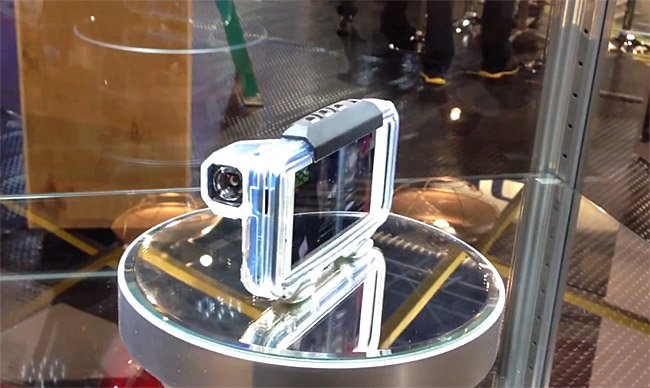
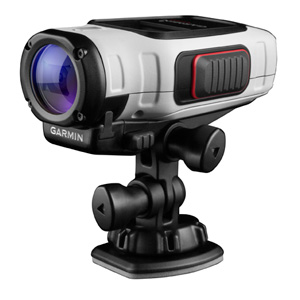
The Garmin VIRB, is touted as a “go-anywhere-endure-anything 1080p action camera with: built-in color ChromaTM display for setup and playback, 2000mAh battery (up to 3 hours of HD recording), and a 16 MP image sensor.”

Enclosed in a ‘rugged’ waterproof enclosure, the VIRB also provides heart rate, altitude and velocity to help set it apart.

https://www.youtube.com/watch?v=F6CGI3XkAiQ&feature=youtu.be

Cost: $299.99 USD

Posted by: Lawrence

Reading Time: < 1 minute

I’m a big fan of G-Form products and not so long ago we reviewed the G-Form Elbow Pads which I now wear religiously for snowboarding.

G-Form announced during CES 2013 that in June of 2013, they will sell the G90 waterproof phone case with a 90° angled lens/mirror with up to an impressive 140° field of view (your existing smartphones lens will determine the exact field-of-view you’ll get). Because smartphones are so narrow, the G-Form set-up is more aerodynamic and poised to give GoPro, Vholdr, Drift and others a run for their money.

Posted by: Lawrence

Source: Gizmodo

Reading Time: 2 minutes

We got like 6″ – 8″ of snow where I live in the Northeast and it’s been hanging around. The first few days I did some snowshoeing, but over the next few days the snow melted just enough to get crusty and the trails got pretty tracked-out and I was relegated to hiking. Given my longstanding hatred of treadmills and the fact that the surf has been relatively flat, I needed a plan C to get back out and de-stress.

Click to enlarge image

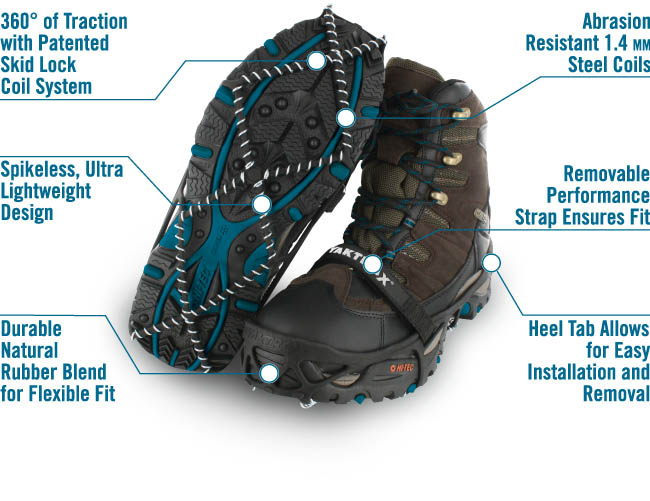
I run trails and from time-to-time with my friend and neighbor Dan and he asked if I had Yaxtrax and wanted to go on a run – I didn’t, but a run sounded great. So today with my new Yaktrax Pro’s I hit the frozen, muddy, snowy tracked-out trails not expecting much from these spikeless, rubber and coiled-metal contraptions that slid over my regular running shoes and fastened over the forefoot with a single velcro strap.

For the first mile or so I took it easy, gently testing lateral movement and I felt as locked in as though I were on dry ground. By miles 3 and 4 I was cutting confidently through treed trails like Barry Sanders cutting through the Bears defense. OK, maybe more like Colonel Sanders cutting through a boneless variety bucket, but I gotta say I was impressed with the way these things held ground.

Features of the Yaktrax include:

  • SPIKELESS, ULTRA LIGHTWEIGHT DESIGN
  • 360° OF TRACTION WITH PATENTED SKID LOCK COIL SYSTEM
  • DURABLE NATURAL RUBBER BLEND FOR FLEXIBLE FIT
  • ABRASION RESISTANT 1.4MM STEEL COILS
  • REMOVABLE PERFORMANCE STRAP ENSURES FIT
  • HEEL TAB ALLOWS FOR EASY INSTALLATION AND REMOVAL

For anyone looking to hit the trails in suspect conditions, trust the Yaktrax – they work. Price: $25-30.

Posted by: Lawrence

Reading Time: 2 minutes

For a geek like me, running gadgets are hard to resist. GPS watches, heart rate monitors, running belts, iPhone in armband, earbuds… I own them all and not surprisingly, I’ve run with them all… at the same time.

iPod Nano and Nike+

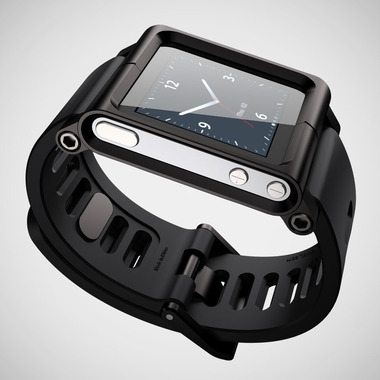
TikTok LunaTik band, multi-touch iPod Nano 6G & Nike+

Maybe it’s the barefoot craze and the notion of going lighter, I’ve talked about going lighter in the past, but never did anything about it. Well this season I put my robo-cop runs behind me and the only gadget I need is my Nike+ and iPod Nano 6G.

I’ve been running with my wrist-mounted Apple Nano for about a month now and can only find a few drawbacks. First, I like to overlay my runs on maps from time-to-time (especially when I travel) and without a GPS (or an iPhone equipped with GPS and an application like NaviGadget) I’m not sure if it’s possible. If anyone knows of a way to do this please leave a comment! The second drawback is that I’m forced to wear headphones when I run. With my iPhone I can put it in my armband upside down so the speakers face upwards. With the volume turned-up, it’s perfectly loud enough to hear without the need for headphones. There are very small speakers out there, but the current designs are not ideal and anything smaller would probably not be able to generate the volume needed.

For my purposes, the good outweighs the bad and there are plenty of features the Nano and Nike+ offer that replaces the need for multiple gadgets. For instance…

  • The Nano has a built-in FM radio that works remarkably well
  • The Nano has a built in Pedometer to track your movement all day long
  • The Nano allows you to listen to Podcasts (which I love for longer drives)
  • The Nano has a very simple interface that makes it easy to retrieve run data at the push of a single button

Beyond the benefits of the Nano as a running device, coupled with the stylish LunaTik watch band (starting at $79.95 USD*), it also makes a great everyday watch. I’ve received numerous compliments and have persuaded more than a handful to buy their own. The TikTok bands are nice enough to wear when you’re dressed up and they have recently introduced new models like the Black version (which I totally want). Speaking of colors, the Nano allows you to alternate between a black or white watch face to match your outfit – hopefully one day they’ll add more colors!

* The TikTok models are also very sporty and start as low as $39.95

If you’re looking for a reasonably priced running watch, look no further than the iPod Nano 6G with a TikTok + LunaTik band and the Nike+ system. It’s a light, easy-to-use and stylish set-up that will track all your runs and more.

Reading Time: 3 minutes

I’m a big fan of capturing moments on film and reliving them just after the fact and years down the road. I have the whole saga of getting married on tape starting with the proposal and on through to the honeymoon (easy, I’m talking about the snorkeling in Maui and the helicopter ride in Kauii).

This December a couple of friends and I hit Snowbird for some early season pow and caught it on tape using the Vholdr CountourHD and a GoPro (link). It was a good way to capture some side-by-side comparisons and left us wanting more (powder and side-by-side comparisons). From these tests, one of the most obvious differences was how important field of view is. With a smaller field of view you have to do a much better job of staying focused on the subject your recording (less margin for error). The GoPro did a better job here than the Vholdr.

Bitness reviewed the GoPro as far back as 2007 and a few years ago the Vholdr CountourHD. After carrying around a full-sized camera for so many years, unpacking it to shoot, worrying about falling with it or changing the way I rode to accommodate a good shot, well… the helmet cams were an epiphany.

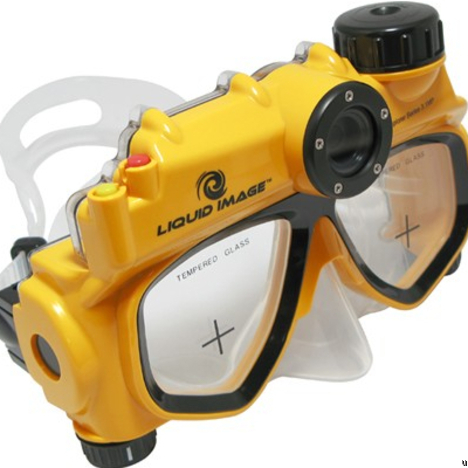
Both Vholdr and GoPro have made improvements since our first tests. Vholdr has introduced a GPS version of it’s camera and GoPro greatly improved resolution and introduced myriad mounts and adapters. There are also two new cameras on the market I’m keen to test, the Drift HD170 and the Liquid Image Summit Series. Both are vastly different in appearance than the Vholdr and GoPro and both offer some unique characteristics. For example, Liquid Image creates a series of cameras in different form factors, for different sports. Rather than adapting the camera to your sport with special mounts, it comes ready-to-go for snow sports (Summit Series), motor sports (Impact Series) and water sports (Scuba, VideoMask, Explorer Series and Freedom Series).

The Drift is a durable looking camera and the only one in the lot to include a built-in LCD (GoPro has recently announced their LCD BacPac). The Drift also includes a remote control you can wear on your wrist – very cool since my friend is always asking if his GoPro is on (with the Vholdr it’s easy to know if you’re on or off since the mechanism slides forward for on and back for off).

Below is a quick look at what we felt were some of the more important metrics to consider when looking for a ‘helmet’ camera. Bitness is coordinating on a hands-on review of all 4 cameras tested under similar circumstances. Video quality, sound quality, picture quality and ease-of-use will be the focus of those tests.

Camera Specifications
Make Model Field of View Megapixels Memory Battery Performance Weight
Liquid Image Summit Series 136° 12* 4GB Micro SDHC 1.5hrs .24kg
GoPro Hero 127° 5 0 2.5hrs 167g
Vholdr CountourHD 110° 5 2GB MicroSD 2hrs 116g
Drift HD170 127° 5 32GB 2-4hrs 157g

* interpolated

Notes:
All cameras provide audio
All cameras are expandable to 32GB
Vholdr, GoPro and Drift cameras support multiple resolutions up to 1080p
Liquid Image model is currently 720p with a 1080p model planned for Fall 2011
Field of view (FoV) for 1080p, expect wider FoV for lower resolutions
Battery life depends upon recording resolution, use of LCD and other configurable options

Camera Accessories/Other
Make Model Mounts Waterproof USB LCD Other
Liquid Image Summit Series N/A No** Yes No specilty models
GoPro Hero handlebar, surf, wrist, suction cup, roll bar, chest, helmet, head, tripod To 60m Yes Optional widest array of mounts
Vholdr CountourHD handlebar, goggle, helmet, rollbar, surf, suction cup, tripod To 10m Yes No  
Drift HD170 handlebar, goggle, helmet, head strap To 0.5m Yes Yes remote control can be work on wrist

** Liquid Image waterproof models such as the Scuba Series are waterproof to 40m

Notes:
Waterproof measurements are performed with cases on the GoPro and Vholdr. The Drift needs no case

Posted by: Lawrence

Reading Time: 6 minutes

Okay, let’s just see a quick show of hands… How many of you already own a heart rate monitor of some description? Okay, quite a few of you. Alright, keep your hands up if you know how to use your HRM?  Hmmm, okay, a few hands went down. Quizzical looks on a lot of faces are telling me that a lot of you sort of know how to use your HRM, but are not sure.

Okay, one more round of questions, then: How may of you know about heart rate training zones? Okay, quite a few of put your hands up. Now, keep your hands up if you know about your heart rate training zones, as in your Max HR, your Aerobic Endurance zone, your Tempo zone, and so forth.  A few hands went down, but some more quizzical looks on faces.

You see, the problem is that, before I go and recommend which heart rate monitor you should buy for your training, I have to acknowledge that there is a lot of confusion and margin for error in this whole area of training with heart rate zones, which is why most of us buy an HRM.  So, I am afraid I feel the need to bore you with some explanations, in an attempt to clear up some of that confusion and reduce some of that margin for error. Then, we’ll get to the gadget stuff in a few minutes.

Heart rate training zones
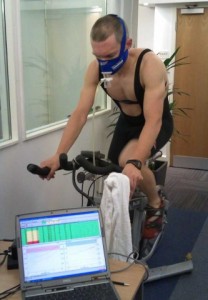
If you read some of the web sites, magazine articles, books or HRM owner’s manuals, it sounds like heart rate training zones can be calculated fairly quickly and then you can head off to do your exercise, confident that you are targeting a specific type of fitness. But, they’re not so easy to calculate accurately and most calculations that don’t involve a scientific test (usually something like a VO2max test) are going to be prone to a lot of error. Problem is that a VO2max test can be expensive ($100-200 or more), can be time consuming (about an hour in total), and require specialists to conduct them. It is sooooo much easier just to follow the “typical guidelines” and then get started than it is to find the time, money and appropriate specialist to do a VO2max test.

But, let me give you an example of how badly you can get it wrong if you follow some of the “typical guidelines”. Many will tell you to take the number 220 and subtract your age if you want to estimate your Maximum Heart Rate for running. So, a 45 year-old guy like myself should have a maximum heart rate of 175 beats per minute (bpm). Except, my Max HR was tested on a treadmill last year (need to get another test done this year, sorry for the old numbers) at 188 bpm. So, if I follow the “typical guideline” and decide I want to target a tougher training zone for intervals on the track, they tell me I should train at 80-85% of my Max HR, or a Tempo training zone of 140-149 bpm. Which would be completely wrong for me, because I found out last year that my Tempo training zone is 151-161 bpm (80-86% of Max HR). The 140-149 bpm zone would be totally counter-productive for me – not hard enough to be improving my speed or power, but too hard to develop aerobic endurance, and I would not see the kinds of fitness gains I had hoped for if I followed the “typical guidelines”.

So, if you want to take this stuff seriously, then get a VO2max test done by an experienced professional and get more out of your training and your HRM.

The other approach you could take would be much less expensive, much more time-consuming, require you to listen to your body, and won’t give you any useful numbers for a while. You could use a heart rate monitor and write down your heart rates at key points in your work-outs (you’ll have to talk to your coach about this for more specific details), and then after several months of regular recording of your numbers, alongside your pacing and Rates of Perceived Exertion, then it might be possible to estimate your personal heart rate training zones.

Heart Rate Monitors
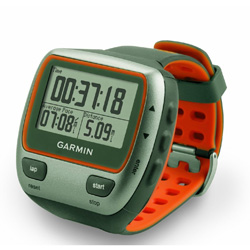
Well, the good news is that you don’t need to go out and buy the latest and most expensive HRM on the market. Of course, the latest and most expensive HRM on the market might have all the features you’d really like to have in an HRM (GPS mapping for speed, distance and route maps, downloadable to your computer, totally waterproof, extended battery life up to 20 hours, perfect for iron-distance triathletes…), like the Garmin Forerunner 310xt pictured to the right there ($300-400). But, there are also plenty of lower priced heart rate monitors that do a great job and cost about 1/4 the price.

So, what would I say are the most useful minimum set of features that an HRM needs to have?

  • Measuring heart rate reliably (well, duh!)
  • Stopwatch with lap counter (total number of laps depends on what you’re doing, really, but the more the better for long-distance people who might want to know their mile splits on a marathon, or perhaps their lap splits for a long track session)
  • Interval or count-down timer (useful if I say, want to do some fartlek with a burst of speed for 100 strides every 4 minutes, or something)
  • Waterproof to 50m (for those of us who also like to time our swims in the pool, not necessarily with HR, but still handy to be able to use the stopwatch with lap counter fully submerged in the water)

My favorite heart rate monitor in the “entry-level” category, that fits all the criteria mentioned above, sadly, is not made any more. It is a Nike Triax C8, it cost me about $80 five years ago, and it still works brilliantly to this day. Sadly, Nike seems to be more focused on footwear and watches that make fashion statements and I could not find any new HRMs currently available that I would recommend.

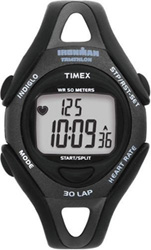
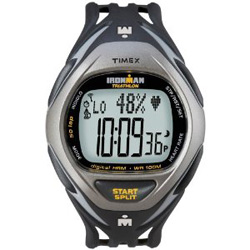
However, Timex do make some HRMs that are very reasonably priced and seem to have all the features mentioned above. I owned an Ironman-branded Timex watch before I had the Nike Triax HRM and it was very good value for money (but it was not an HRM) and lasted through my first 3 years of triathlon training in all kinds of water, weather and conditions. The Ironman Race Trainer model, pictured to the left, seems to be a very good one with all the features you might need to get started (and it can cost a lot less if you buy it on Amazon).

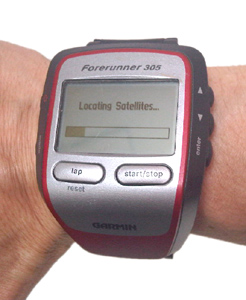
Garmin also do some very good models that are not as expensive as the 310xt. For example, I own a Forerunner 305 (the one pictured at the top of the article on my wrist) that costs about half of what the 310xt costs and is great for long runs. It is not water-proof, so I can’t wear it when I swim, and the battery life is only estimated for 8 hours, so I can’t use it for iron-distance training or racing situations. But, it has been so useful to have GPS distance and speed measurements available for the lower price.

More information, advice and selection
There are still a lot of other factors you may want to consider when buying and HRM. Is the heart rate strap compatible with your turbo trainer? Your treadmill? Your cycle computer? Will it work with Nike+ and iPod accessories? Other gadgets you might use in your training?  How does it feel when you are wearing it (the Garmin HRMs shown here in this article are very bulky and uncomfortable)?  These are also important questions to think about, and don’t make your purchasing decision any quicker or easier, but can make your usage of the HRM a lot more beneficial in your training.

HeartRateMonitor.co.uk is an excellent resource for people in the UK, and HeartRateMonitorsUSA.com for people in the US, who want to learn more about heart rate monitors, features, and objective product reviews, alongside an impressive range of products for sale on their web sites.  So, check them out, too, and get as much information as you can handle before making your purchase.

Reading Time: 2 minutes

I’ve always marveled at how small retired NBA basketball and now actor John Salley’s ears are. Truth is I have small ears too – not as disproportionate as Mr. Salley’s who at 6’11” has ears the size of nickels, but small nonetheless.

Having small ears was never a big deal back when headphones were worn over the ear, but most headphones today (and Bluetooth headesets) are of the earbud variety and for people like me and JS, keeping earbuds in your ears, particularly when sweaty from working out, is damn near impossible.

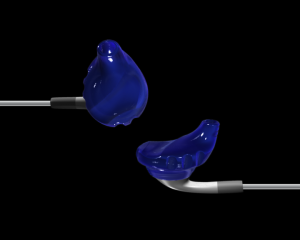
Yurbuds™ have an earbud system that caters to people of all ear types and is specifically designed to keep the earbuds in your ear even through intense physical activity. Yurbuds are two soft rubber ‘boots’ that fit over the provided ‘Apple-style’ earbuds, but can be used with other earbuds or headsets as well. The Yurbud has a small funnel of sorts that fits into your ear canal and the outer-ridge of the Yurbud is grooved, helping them stay in place – even when sweating heavily.

When you order your Yurbuds you submit a picture of quarter placed just below your earlobe. This helps them determine the size of your ear and fit you correctly to Yurbud for your ears. In all my tests of the Yurbuds – running in near 80F+ degree heat for an hour, the Yurbuds never moved and never bothered me. I also got caught in a thundershower on a run (never fun) and again, the Yurbuds hung in there and Mishka kept signing me up the hills and back to my home.

Because Yurbuds are comfortable over long periods of time and stay in place even while sweating, they’re perfect for runners, bikers, and amateur athletes who are looking for a headphone solution you barely even notice.

Priced a very reasonable $29.99, Yurbuds are the perfect solution for anyone looking for headphones that stay in your ears regardless of how much you sweat or for anyone just looking for a more comfortable earbud from prolonged use.

Posted by: Lawrence

Reading Time: 5 minutes

Swimming

The sound of zipping up your wetsuit early in the morning.

The small ripples you make in the water when you get in. The splashes other people make when they get in.

They squeal and make high-pitched noises, but you have done this so many times before in much colder conditions, you just sink into it quietly and don’t make much noise. Warm up slowly, get the blood moving gradually.

The even steady rhythm of hands entering the water, good catch at the front, full stroke all the way through, relaxed hand and high elbow recovers to the front.

There is a tiny drip-drop sound that droplets of water make as they drip off your hand when it recovers back to the front and then you smoothly, purposefully place your hand back in the water.

Your legs don’t make much noise when you kick steadily and smoothly. It’s more like a percussive beat in the background.

The sound of your breathing, quick strong inhale, slow steady exhale.

Your ears might be covered by your swim cap(s) and you are cut off from the rest of the world.

Consistent breathing every 3 strokes, sometimes every 4 or 5 or 6 or 7 strokes.  At the very beginning and at the very end, maybe every 2 strokes.

Your heart beating in your ears. The hands, legs, breathing, heart all fall into synch with each other.
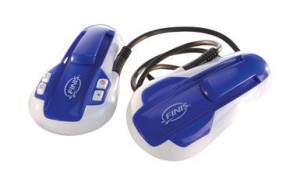
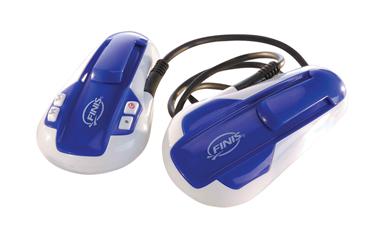
How is it that people get bored when they are swimming? How is it that they say they don’t have enough to occupy their minds and ears?  As cool a gadget as it seems, I can’t imagine wanting to get the Finis SwiMP3 player, myself.  There is more than enough for me to listen to. Maybe when I start swimming more than 5k I’ll think differently…

Cycling
Cycling shoes clicking into pedals. When you can do it without looking down, when you know the feel of the shoes and the pedals and you’ve done it 100 times before and all you need to do is listen for the right sort of click sound. (There is a wrong sort of click sound that sounds like the right sort of click, but isn’t exactly the same.)

The sound of fully inflated tires against smooth pavement. Whizzzzzzz along early in the morning, going off to meet some friends for a long ride, or maybe just head off on your own.

The clean, well-oiled chain as it zips around the rear cassette up towards the front chainring and back around through the rear derailleur.  Smooth and nearly silent. When the morning is quiet enough and the streets are empty enough, you can hear it.

The clacking-buzzing sound of the freewheel, when you stop pedaling and the back wheel keeps spinning and it makes that sound of freewheeling.

The steadier, slower rhythm of pedaling uphill. Move the bike, not the body, keep driving down and all the way around on the pedals. Steady, maybe slightly uneven rhythms. But it’s your rhythm, and when you feel good, you own that rhythm.

Up out of the seat and harder on the pedals, picking up the pace on the hills and pushing a little faster.

The sound of your breathing getting heavier on the hills. Most of the time you don’t notice the sound of your breathing, not like you do when swimming or running. But, on the hills you notice.

You don’t need to look at your heart rate monitor to know how hard you’re pushing, how much longer you can hold it like that. When you’ve done it 100 times before, you just know. And sometimes you push harder, sometimes you hold something back for later. It’s your rhythm, your choice.

When you go really fast downhill and stop pedaling, you probably can’t hear it any more. The wind is rushing through your ears, your helmet, your clothing so fast that all you hear is fast-moving air.

You take a drink on the downhill and re-fuel for whatever comes next. The sound of a bottle that is almost empty, liquid sloshing around audibly. Needs to be switched with another bottle you brought or one you’ll get at an aid station.

Brakes touching the rims. Slowing down slowly, steadily or abruptly.  Metal rims sound different than carbon rims.

You can hear when your brake pads are getting too worn out, feel when the cables need a little tightening.

You can hear when your wheels aren’t true and the spokes need tightening.

You can hear when the brakes aren’t in perfect alignment.

You can hear when the derailleur needs a little adjustment.

You can hear when cars are approaching from behind.

You can hear around corners, sometimes, approaching cars from the sides or up ahead.

Not always, but sometimes you can hear another cyclist come up behind you.
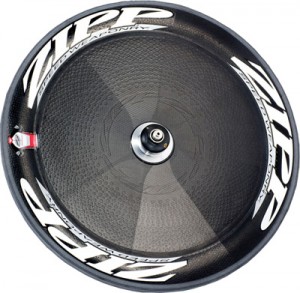
Those guys with the disk wheel on the back, you can hear them coming a mile away. It’s like a noise Darth Vader would make if he were riding a bike, like some hellish, basso profundo, voof-voof-voof sound that is coming to get you and you are helpless to escape.

Who on earth would want to listen to music on a bicycle?  There is so much to listen to, to listen out for.

Well, maybe on the turbo trainer. Yes, I will admit to making playlists and listening to music when stationary. But, never when I’m out on the road.

Running
Pulling on compression socks, for a longer run, strapping on a heart rate monitor or a GPS to tell you how far, how fast, how hard. Small sounds, maybe the occasional electronic beep to tell you something is activated or there’s an error message.

I can understand people wanting to listen to music while running. Most people seem to run because they feel they HAVE to run – maybe it’s the cheapest, easiest way they can think of to lose weight or stay in shape. But, if you LOVE running, then it’s different. There’s plenty to listen to without music in your ears.

The sound of your feet hitting the ground. You can tell a lot from the sound your feet make, if you listen out for it. Pronation, supination, heel strike, fore-foot strike, strong ankles, wobbly ankles, short stride, long stride.

The surface you run on makes a big difference, too. The relative flat sound of running on streets, up and down sidewalks. The gravelly sound of running on paths. The crinkling, crunching sound of leaves and twigs and grass on a trail.

Your breathing is much more pronounced when running. Your heart rate will probably be more elevated than in the other two sections.

You can hear it more in your ears, feel it more in your whole body, your breathing, your heart pounding.  It’s more like it was on the swim, but now the sounds from all around you are part of it, too.

Early in the morning, you can tell the changing of the seasons, predict the weather for the rest of the day by listening to the birds around you, even in the densest most crowded cities.

Need to listen out for cars, too. Hybrid cars have the unfortunate distinction of being the toughest to hear coming, so you need to be specially careful about them.

There’s always music playing in my head. Not full songs, but usually my favorite bits that I keep playing over and over again.

The bass intro to “Superstition” by Stevie Wonder, up until “Very superstitious writing’s on the wall.”

The intro to “Back To Life” by Soul II Soul, up to “Back to life, back to reality.”

The chorus of “Sex on Fire” by Kings of Leon, as well as the line “Hot as a fever, rattling bones.”

Who knows what will play in my head next time. Something I heard on the radio this morning, something I heard 25 years ago at Danceteria (“A E A E I O U U, and sometimes Y-ii”? oh, no!), something my daughter played over and over again last week (“promise I made, promise I made, started to fade, started to fade”? hmm, okay…). I know I can’t sing worth a damn. But it always sounds great in my head.

Reading Time: 5 minutes

Sorry for the long silence. Been away for a while, getting stuck into my big challenge this year: training for my first ironman triathlon (the Forestman).

For those of you who didn’t know (and if you already knew this, then please allow me to try and impress you once more with the sheer numbers), an ironman triathlon involves 3.8 km (2.4 mi) of swimming, 180 km (112 mi) of cycling, and 42.2 km (26.2 mi) of running, all in one continuous event, with the clock running the whole time.  A guy like me (45 years old, been doing triathlon for about 8 years now, training pretty regularly, but not winning any medals in any races) will do about 75-85 minutes of swimming, about 6-6.5 hours of cycling and 4-4.5 hours or running at the end of it all.  The top guys will routinely finish in under 10 hours, bless ’em. But, I’ll probably be looking at something closer to 13 hours (gotta include time in transition between events, since the clock is always running, and it makes sense to take 10-15 min to dry off and put some clean socks on before you set off for a 6-hour cycle ride, rather than rush through it and be uncomfortable or getting blisters for the next 6 hours). Most courses will have about a 17-hour cut-off point after which they have to clear the course of anyone who hasn’t finished by sun-down.

Tapering
My race is about 2 weeks away now, so I am officially in the “taper” phase of training, which means I am doing fewer and fewer hours of training each week (at my peak, I was doing about 15-20 hours each week, now I am down to about 10-12 hours a week), so that I get to race day feeling fresh and well-rested. But, at the same time, I am trying to keep the intensity of each session quite high, so that I keep my fitness levels and sharpness high for the day of the race. But, it has also given me more time to step back and reflect on what I have been doing this year, think about the training I have done so far, and what factors have contributed to getting me this far.

Milestones and motivation
Some ups, some downs, and some key milestones along the way. It helps to have some carefully targeted events to measure your progress and keep you motivated along the way, such as:

  • Back in early April, I did a 5k Swimathon for charity, which was an excellent exercise in settling into a good steady pace for 102 minutes of non-stop swimming. And it gave me a lot of confidence to know that I could swim way more than the 3.8k I’d need to swim in an Ironman. Of course, at the Swimathon, I swam next to Dan Bullock, one of Britain’s fastest veteran swimmers, which was simultaneously humbling and inspiring. He finished in about 62 minutes, or 40% faster than I did.
  • A few weeks later, I got offered a last-minute spot in the London Marathon, and I managed to get around in 3 hours and 28 minutes, which I was very pleased with.
  • Lots and lots of long cycle rides with fellow triathlon club members, including one super-gorgeous, super-tough day of about 130 miles trying to keep up with some incredibly fast, ridiculously tall guys 10 and 20 years younger than me.  Again, humbling and inspiring seems to be the theme to my training this year.
  • Joined a relay team to swim across the English Channel to raise money for charity, later on in September. That has given me something to look forward to once the Forestman is over (and lots of people tell me about the post-ironman blues, that anticlimactic feeling that sets in after achieving such a big goal as this).

And, I’ve learned a few valuable lessons along the way, about myself and about some of the people in the triathlon community around me…

  • Given half a chance, your typical triathlete who trains for ironman-distance races, will become obsessed.  I mean, if you are an amateur athlete then trying to find 15-20 hours a week in which to do all your training, you kind of have to be obsessed. It helps that I am a triathlon coach and so some of my training gets done in the course of working. But, family, friends, holidays, working schedules, sleeping routines, meal times, and your favorite TV shows will all end up taking a back seat to this all-consuming passion.  There’s no way to sugar-coat it: I have seen my fair share of marital strife, disappointed friends, and unhappy kids this year and some parts of my life are in worse shape than they were before I started this.  Has it been worth it? Ask me in a few weeks.
  • We also can be very boring companions, we iron-distance triathletes.  There are times that the only people who want to be around me are other triathletes, especially those who are also doing iron-distance training. I typically run out of small talk within 15-20 minutes and eventually resort to ironman-related conversation, pretty much wherever I go, whatever I do.  I have been known to recommend to 20-something fashion models that they eat sports gels and drink sports drinks, instead of resorting to their natural diet of coffee and cigarettes, in order to get through their rigorous schedules.  So “bored incomprehension” is the look I am getting used to seeing a lot more these days.
  • And, when we’re not training, we’re recovering from training, or we’re eating everything in sight, or we’re going to bed early to get ready for the next training session.  So, in the other hours of the day that we’re not training, it still is all about the training.
  • Once you give in to the obsession, get used to the unsociable hours, and accept the fact that all of your friends and family have given up on you, it really isn’t so bad. If you’re lucky enough to find some other people to train with, then you can all motivate each other and commiserate with each other. But, the actual training itself is really not that tough. You will go slower than you would normally go for shorter distance training, and you just have to stick it out for a lot longer. Boredom is probably the toughest part of an 8-hour training ride or a 4-hour training run.
  • You can probably eat anything you want while you are training for iron-distance races, and you will still probably lose weight. Not that you should subsist entirely on ice cream and coke, but you probably will have to consume a huge number of calories to get your body back in balance when you get back from an 8-hour training ride. If you choose to consume 2000 kcal of salad and whole grains, that is great! If you choose to consume 2000 kcal of  burgers, fries and ice cream, then that ain’t so bad, either.
  • It’s worth saying one more time that without the support and camaraderie of my friends at Tri London, I would not have made it through that tough, freezing winter with so many useful hours of training under my belt.  Whatever I do at the race on June 27 will be almost entirely due to the support of people like Kev, Roz, Lance, Guido, Andrew and Stephen, dragging me around Southern England at 6am almost every Saturday, and waiting for me at the end of every hilly climb.

Still feels like a long way to go, and maybe longer still once I sign up to do it all over again next year.

Posted by: Robert

Reading Time: 3 minutes

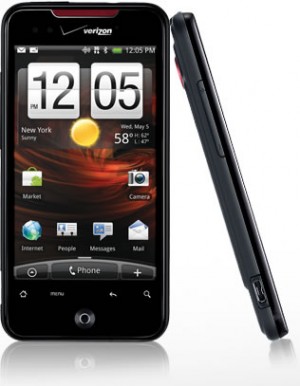
Android continues to mature in the smartphone market and the HTC Incredible on the Verizon network gives the Apple iPhone a whole host of reasons to take notice. First and foremost the HTC Incredible gets a signal, an increasingly difficult task at least for myself and fellow iPhone/AT&T users in our neck of the woods (from time-to-time my “neck of the woods” includes New York City).

A fast and fully-featured Smartphone, the HTC Incredible works extremely well for both voice and data. It’s a light, sleek phone you barely notice in your pocket, yet is packed with power and features that surpassed any preconceived notions I had going into the tests.

The iPhone continues to be the benchmark for Smartphones and happens to be the smartphone I pay dearly for month-after-month. While Apple prepares to roll-out the iPhone 4 on 24-June, 2010 with a number of new features, I may very well be a Verizon customer before then. The HTC Incredible on the Verizon network out-performed my iPhone in coverage, voice clarity and network speed (browsing) and already includes multi-tasking and folders (2 examples of what to expect in the new iPhone iOS 4). If the Incredible provided a wi-fi hotspot or tethering (something out-of-the-box and not rooting or installing anything), I would have already made the leap.

Interface
The HTC Incredible’s interface takes some getting used to. It wasn’t obvious to me how to quit an application and stop it running in the background. Not only does this tax the processor, but when I finished testing Skype (great sound quality over the 3G network in my tests by the way), I inadvertently left the app running and kept myself logged-in for the rest of the day.

HTC’s updated ‘Sense’ user interface, while polished (thanks in large part to a powerful 1GHz processor that can support it), is still not as natural as Apple’s interface in my opinion. I do like the ability to view the separate screens as cards and can quickly jump between with smooth transitions. But in terms of overall ease-of-use, or intuitiveness, the iPhone still has it.

Applications
The Android Marketplace is loaded with free and paid alternatives similar to what you can find in Apple’s App store. Apple boasts roughly four times the number of apps as android (reportedly somewhere around 50,000 apps). While many people don’t like that Apple controls what can and can’t appear in the App Store, it does add a layer quality control. Third party apps are probably the leading cause for Android crashes on what is otherwise a stable OS.

Smartphone Performance
Following are notes about the Incredible’s performance in key areas to consider for any smartphone…
Voice: High quality and with far less dropped calls and a greater service area than Im used to (on existing 3GS iPhone/AT&T)
Data: Fast web browsing. Gmail and Exchange support
Camera: 8-megapixel autofocus camera with video and LED flash
Music: Sounds OK through speaker and very good with headphones (headphones are also required to use the FM radio app)
Display: 3.7-inch AMOLED (800 x 480 pixels) is bright and very vivid
Interface: Sense; Improved over earlier Android units tested, but still not as intuitive as the iPhone
Storage: 8GB expandable to 16GB with microSD card (sold separately)
Speed: Fast processor (1-GHz SnapDragon processor)
Battery: Battery will get most users through the day, but for very active users (music, Facebook, talk, numerous Apps, etc) you will want to either bring along the cable, or balance-out your day better

Price: $199 purchased online with 2-year Verizon contract

Posted by: Lawrence

Reading Time: 3 minutes

I was an early iPhone adopter – before the App store and just stoked on the idea that I had a cool phone and a way to browse the web at decent speeds on a decent-sized screen. The initial gee-whiz of what could be done on the iPhone was soon overshadowed by what it couldn’t do and the lack of certain features continue to stick-out.

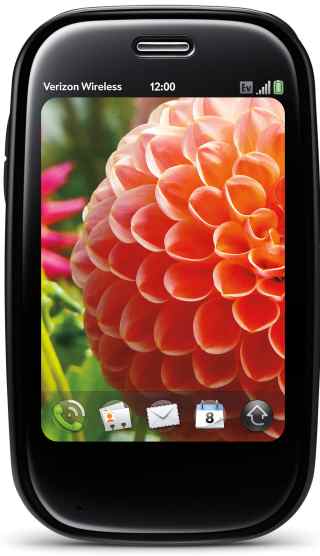
As fast as it looks, the Palm Pre Plus

By far the most glaring omission with the iPhone is the inability to tether it to a computer. While this isn’t a limitation of the iPhone itself (it’s more like a disabled feature) it leaves many, including myself, looking for alternative solutions. The Palm® Pre™ Plus not only let’s you tether (via Bluetooth), but Palm incorporated a mobile hotspot into the Pre which allows as many as 5 concurrent users to jump online.

The Pre is a sleek looking slider phone (keypad slides-out from the bottom) with a built-in camera and flash. It feels nice in your hand and slips easily into your front pocket. It’s so sleek in fact, that it took me a while to find the USB port to charge the phone! I also puzzled over how to close apps (you flick them upwards) and the small keypad gave me fits. When I first receive a gadget I purposely avoid the manual to see how intuitive it is and I have to say the Palm Pre Plus is miles from Apple in regards to ease-of-use.

Voice: In my tests the Palm® Pre™ Plus on the Verizon network performed well, with good sound clarity and clear voice transmission. To dial numbers you use the touchscreen and not the tiny keypad. The Pre worked everywhere I tried it, including spots my iPhone loses coverage. AT&T recently announced plans to spend $18 – $19 billion on network upgrades, but there is far less AT&T coverage in my area than Verizon.

Data: The Palm Pre takes advantage of Verizon EV-DO Rev. A and offers speeds equal or greater than speeds enjoyed on an iPhone 3GS. EV-DO Rev. A data can peak at 3000 kbps, but on average users get around 600Kbps-1400Kbps.

In Rhode Island I enjoyed, on average, 1.50Mb/s download and 0.52Mb/s upload. And in New York City the rates were 1.00Mb/s download and 0.21Mb/s upload. This means in RI I can expect to download a 5MB MP3 file in about 25 seconds, or a 35MB video in 3 minutes – not bad!

If you’re looking for a phone that is very slick looking, offers reliable voice and fast data (for you and up to 5 friends) and you have the patience to read the manual or play with it enough to learn how to use it, then the Palm Pre is a wise choice. Full retail price is listed at $599.99, but with 2yr contract the Palm Pre Plus can be yours for $49.99 (early termination fees do apply). This phone also requires a data package ($29.99 or higher per month). Visit Verizon Wireless for more information.

Specs:
Battery Usage: Up to 330 minutes talk time / Up to 350 hours standby
Dimensions: 3.9″ (H) x 2.3″ x (W) x 0.67″ (D)
Weight: 4.89 oz.
Display: 3.1″(HVGA 480 x 320), 24 bit TFT
Memory: 16GB Flash/512 RAM
Bluetooth® Wireless Technology–(V 2.1+EDR)
3 Megapixel camera with flash
Palm webOS™ platform
Wi–Fi Ready (802.11 b/g)
Music Player for MP3, AAC, AAC+, WAV, AMR, QCELP
Email: Exchange ActiveSync support

Posted by: Lawrence

Reading Time: < 1 minute

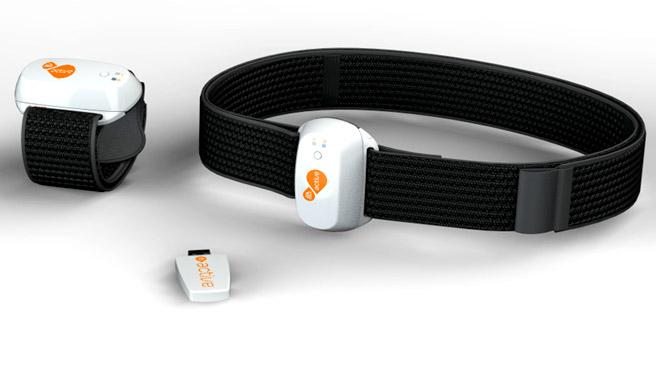
EA has announced EA SPORTS Active 2.0 (working title). Scheduled for release this fall, EA SPORTS Active 2.0 is expected to offer a wireless heart rate monitor, arm and leg accelerometers for use with PlayStation 3, Wii, iPhone and iPod touch.

Users can track exertion in real-time with an onscreen display and also share workouts with other EA SPORTS Active users online. Sharing fitness results, interacting with workout groups and sending messages to other users is expected to keep users inspired and engaged.

PlayStation 3 users will also benefit from the ability to download new workouts and exercises to their internet-connected consoles. Other online features include EA’s’ total body conditioning’ workouts, progressive exercises in a three-phase, nine-week program intended to help provide a fitness road-map while motivating users to stay on track with their fitness goals. An EA SPORTS Active personal trainer can help walk users through a workout and provide continued encouragement with feedback to ensure an optimal workout experience.

Posted by: Lawrence

Reading Time: 2 minutes

Interval training is increased intensity for a given activity (lifting, running, rowing, cycling) for a measured amount of time, followed by a reduced level activity for a measured amount of time. Typically done in sets, interval training can be anaerobic – fat burning high intensity interval training (HIIT) typically focused on starving larger muscle groups of oxygen – or aerobic, where low to moderate intensity is used for a longer period of time, allowing muscles to ‘breathe’ and build stamina.

Both anaerobic and aerobic exercise are beneficial and interval training is a great tool to realize those benefits, while at the same time adding a new dimension to workouts to keep them interesting.

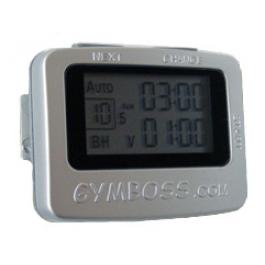
Measuring intervals is easy, but too often it distracts you from your chosen exercise. I’ve been in all-out sprints with my left arm unnaturally poised in front of me so I could read my watch (with difficulty and added risk). Others rely on a partner’s shouts to let them know when to speed up, slow down or stop. A small device called the GymBoss (1 3/4 x 2 1/4 inches) is a lightweight, inexpensive ($20USD) and eliminates the need to focus on anything else but your workout. Clip it to your belt, stick it in your pocket or place it on a shelf for indoors workouts – it’s barely noticeable until a shrill beep, strong vibration or both effectively alert you (to be honest the first time it beeped it startled the hell out of me).

The GymBoss easily satisfies what I would consider my basic need for measuring intervals while running. Others use it to time rounds (up to 99 can be programmed) on the heavy bag or for cycling, weight lifting and other pursuits. Other GymBoss features include…

  • One or two different time intervals from 2 seconds to 99 minutes
  • Auto mode / repeat through intervals
  • Manual mode / countdown timer
  • Stopwatch

The manual is a small double-sided slip of paper they package under the belt clip. If you’re just getting started with interval training and want more information, check out some of these sites so the directions make more sense and you can program the GymBoss accordingly…

http://www.intervaltraining.net/
http://en.wikipedia.org/wiki/Interval_training
http://sportsmedicine.about.com/od/tipsandtricks/a/Intervals.htm

For $20USD you really can’t beat the GymBoss, it does everything it says it does and does it well.

Posted by: Lawrence

Reading Time: 2 minutes

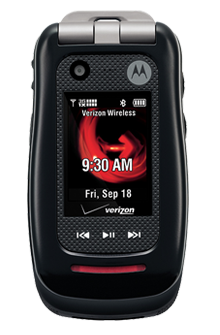
Not everyone needs an iPhone or even a smartphone for that matter. For many, the only functionality needed is good voice quality and the only feature required is reliability. Enter the Motorola Barrage, both uniquely feature-rich as well as durable and providing what I perceived to be above-average voice quality.

Ideally suited for those who work or play outdoors, the Barrage meets or exceeds military specifications for dust, shock and weather. In fact, the Barrage is waterproof in up to one meter of water and submerged for up to 30 minutes. I threw it in the snow, plopped it in a glass of water, took it to the beach and – the test of all tests – let my 6-year-old play with it. Beyond the tested toughness, the Barrage feels like a solid piece of tech, weighing 4.2 ounces and handsomely constructed using black textured rubber and plastic.

Offered by Verizon Wireless for $129.99 (with $50 online discount), the push-to-talk capable Barrage’s 383 minutes of talk-time competes for battery life with a host of features including a 2 megapixel camera (non-camera version also available), music player, bright external 120 x 160 display and TFT internal display (176 x 220).

VCAST and VZ Navigator service are available for additional monthly fees and the streaming in my area was admirable. In my opinion however, the screen size on flip phones in general renders services such as these to be more of a gimmick than useful.

If watching video on the go or you’re frequently going to use the navigation service, you’re better off with smartphone. If you’re the outdoorsy type, or even clumsy, the Motorola Barrage is your ideal phone. With quality construction, a host of features, Verizon’s unparalleled coverage and above-average voice quality, the Motorola Barrage is ready to go to work for you.

Reading Time: < 1 minute

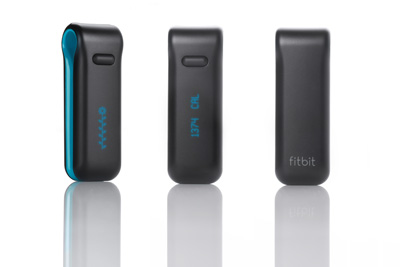
Using built in sensors, the Fitbit captures ‘three dimensional motion’ to provide insight as to the amount of activity and sleep you log each day. It compiles this data and based on your sex, height, weight and age calculates daily the amount of steps taken (reported to be 85-97% accurate), miles traveled, calories burned, calories consumed as well as activity levels (lightly, fairly and very active).

Fitbit

The Fitbit also captures sleep patterns such as when you went to bed, how long you rolled around awake, when you finally crashed and when you woke giving you total time in bed and total hours slept.

Walk within 15ft of the provided basestation and your data is automatically uploaded to the Fitbit website. The website compiles that data for reporting, or to participate in collaborative fitness goals with friends, family and co-workers.

Optimized for walking, running and general activity (don’t try to swim with it), the Fitbit provides a good indication of daily patterns and overall wellness. Priced at $99USD and shipping only in the US, the Fitbit might be the perfect holiday gift for the friend or family member resolved to get in shape for the coming year!

Posted by: Lawrence